
Why Box Bets Are British Racing's Best-Kept Edge
A box bet in horse racing lets you cover every finishing combination of your selected horses in a single wager. Pick three runners for a forecast, tick the "combination" option, and the bookmaker generates all possible first-and-second permutations on your behalf. In UK racing, this mechanism lives inside two products most punters walk straight past — the combination forecast and the combination tricast — and for those willing to learn the maths, it is a combination that pays far more consistently than the default each-way flutter.
Consider the scale of the market you are stepping into. UK horse racing generated a gross gambling yield of £4.1 billion in 2023, according to the Gambling Commission's industry statistics. Yet exotic bets — forecasts, tricasts, and their combination variants — account for only 8–12 per cent of total turnover, with standard win and each-way wagers consuming roughly 70 per cent of the handle. That gap between market size and exotic penetration is where the opportunity sits. When two-thirds of the money flows into simple win bets, the exotic pools and CSF dividends are shaped by a thinner, often less sophisticated, betting population. If your form analysis is sound, the payouts reflect that edge.
The broader ecosystem underlines the point. The Horserace Betting Levy Board posted a record levy yield of £97.5 million for the 2023/24 financial year, a figure that includes contributions from exotic bet turnover. "The Horserace Betting Levy Board's record yield of £97.5 million in 2023/24 underlines the health of UK horse racing betting. Exotic bets, including forecasts and tricasts, contribute meaningfully to this figure," noted Paul Darling OBE, then chairman of the HBLB. Meanwhile, the UK Tote Group reported a 14 per cent year-on-year increase in forecast and tricast betting transactions during the 2023/24 financial year — a clear signal that more punters are discovering the value in combination bets.
This guide strips box betting back to its fundamentals and rebuilds it with UK-specific data: how the terminology differs from American exactas and trifectas, what each variant costs, when the maths favours boxing over going straight, and which race types at which festivals produce the fattest dividends. Whether you have been backing horses for decades or are placing your first forecast ahead of Royal Ascot 2026, every section is built around real numbers, not vague reassurances.
The Box Bet Blueprint: Five Things Every UK Punter Should Know Before Placing a Combination Forecast
- A box bet covers all finishing-order permutations of your selected horses. In the UK, it is called a combination forecast (first two places) or combination tricast (first three places).
- Cost escalates fast: a £1 box tricast on five horses costs £60 (60 permutations). Always calculate total outlay before confirming.
- Target large-field handicaps with 12 or more runners, where CSF dividends typically range from £80 to £5,000 and justify the permutation cost.
- Favourites win only 33 per cent of flat races and 29 per cent over jumps — the majority of results reward punters who cover multiple outcomes.
- Match your box structure to the racing code: flat handicaps offer bigger fields and higher dividends; National Hunt racing demands attention to fallers and completion rates.
Forecast, Tricast, CSF: Translating Box Bet Language for UK Punters
If you have ever read an American betting guide and felt like you were learning a second language, you are not alone. The US exotic bet vocabulary — exacta, trifecta, superfecta — maps directly onto UK equivalents, but the underlying payout mechanics differ in ways that matter to your bottom line. Before you place a single combination bet, you need to know what you are actually buying.
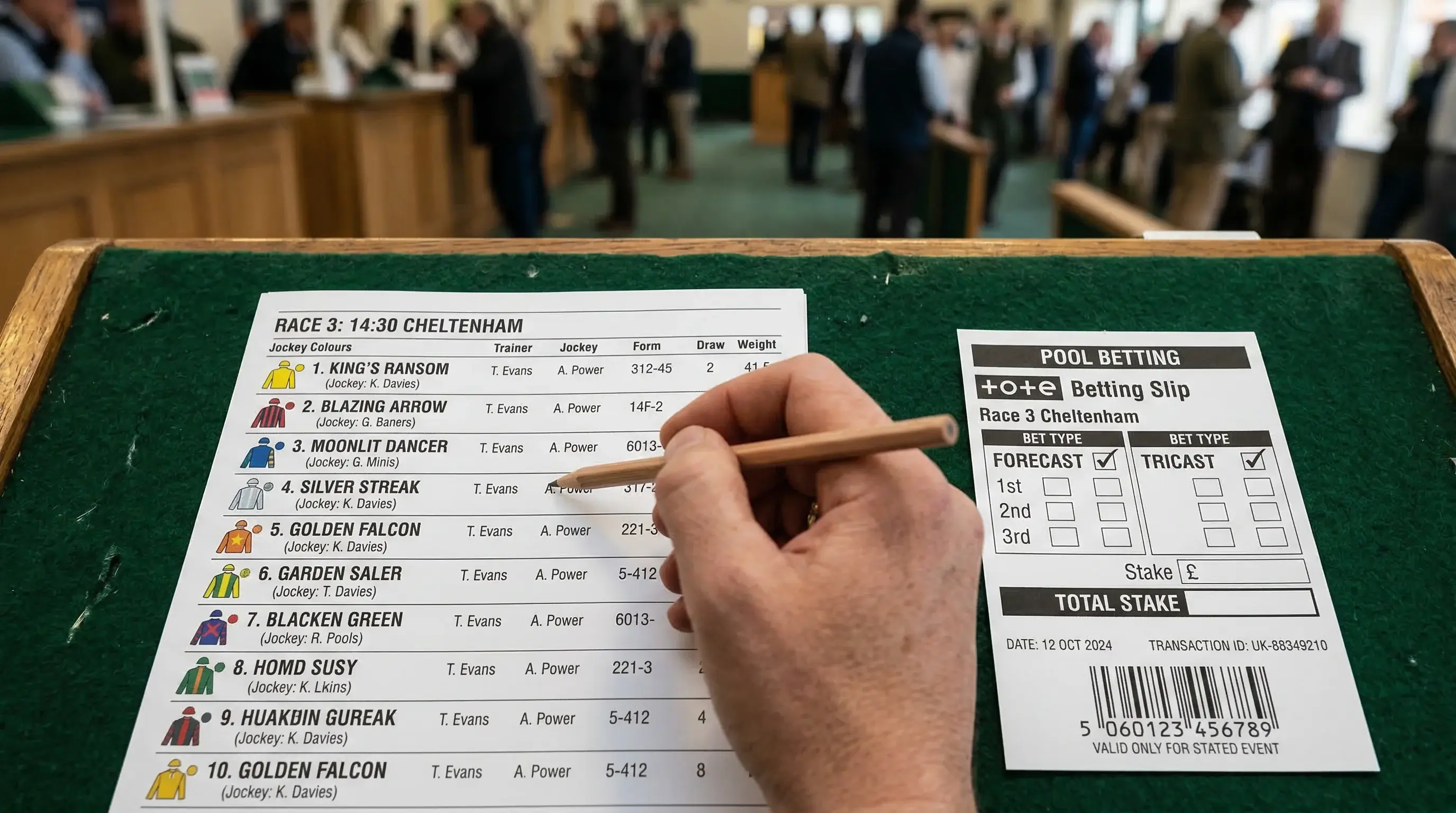
The Terminology Table
| US Term | UK Equivalent | What It Means |
|---|---|---|
| Exacta | Forecast (Straight Forecast / CSF) | Pick the first two finishers in correct order |
| Box Exacta | Combination Forecast (Reverse Forecast for 2 selections) | Pick two or more horses to finish first and second in any order |
| Trifecta | Tricast (Straight Tricast / CT) | Pick the first three finishers in correct order |
| Box Trifecta | Combination Tricast | Pick three or more horses to finish in the first three places in any order |
| Superfecta | No standard UK equivalent (some operators offer "First Four") | Pick the first four finishers in correct order |
The label changes are straightforward enough. The real divergence is in how payouts are calculated, and this is the single most important concept UK punters overlook.
CSF vs Pool: Why British Payouts Work Differently
| Feature | CSF / CT (UK Fixed-Odds Bookmakers) | Tote Exacta / Trifecta (Pool) | US Pari-Mutuel (Pool) |
|---|---|---|---|
| Payout determined by | Algorithm based on starting prices | Pool size and number of winning tickets | Pool size and number of winning tickets |
| Influenced by late money? | Only indirectly (via SP movement) | Yes — directly | Yes — directly |
| Takeout/overround | Built into the algorithm | Tote deduction (typically 13.75% Exacta, 16% Trifecta) | Track takeout (typically 15–25%) |
| Minimum stake online | £0.10 per line | £0.10 per line (Tote online); £1 on-course | Varies by track ($1–$2 typical) |
"British racing's forecast and tricast markets are fundamentally different from American exotic pools. CSF is calculated by an algorithm, not by pool size, which means the payouts reflect true probability rather than crowd sentiment," explains James Willoughby, racing analyst at Timeform. That distinction has practical consequences. In a US pari-mutuel system, a flood of late money on the favourite depresses the exacta payout for everyone holding that combination. With CSF, the payout is derived from an algorithm that references the starting prices of the runners involved. It is still affected by market moves, but the mechanism is mathematical rather than directly redistributive.
For box bettors, this matters because CSF dividends can diverge sharply from what a pari-mutuel pool would pay. In races where the favourite drifts late but still runs well, the CSF may pay more than the equivalent Tote Exacta. Conversely, in races with a heavily backed short-priced winner, the Tote pool — fed by recreational money — sometimes offers better value than the algorithmic CSF. Knowing which system is operating on your bet slip is not a detail; it is the foundation of your expected value calculation.
One final note on language. If you box two horses in a UK forecast, most bookmakers label it a "reverse forecast." Box three or more, and it becomes a "combination forecast." In the US, both scenarios are simply called a "box exacta." The function is identical — the branding is not. When you see "reverse forecast" on a bet slip, you are looking at the simplest possible box bet: two horses, two permutations, double the unit stake.
Box Exacta, Trifecta, and Superfecta: Every UK Variant Explained
Box betting in UK racing comes in three main flavours, each escalating in complexity, cost, and potential reward. Understanding the differences is not optional — it is the difference between a controlled investment and an accidental £120 outlay on a casual Saturday at Newmarket.
Box Exacta — Combination Forecast
A box exacta, known in UK parlance as a combination forecast, asks you to select two or more horses to fill the first two finishing positions in any order. When you select exactly two horses, the bookmaker generates a reverse forecast — two permutations (A first, B second; B first, A second). Select three horses and you get six permutations; select four and you get twelve.
The formula is simple: n × (n − 1), where n is the number of horses you include. Each permutation carries your unit stake, so a £1 box exacta on four horses costs £12. The appeal is straightforward: you do not need to predict who beats whom, only that your selections occupy the top two spots.
Payouts depend on whether you are betting through a fixed-odds bookmaker (CSF algorithm) or the Tote (Exacta pool). In either case, the dividend scales with field size and the starting prices of the placed horses. Handicap races with 16 or more runners routinely produce CSF dividends above £100, making the combination forecast a high-value proposition when your form analysis narrows the field to a strong shortlist. On the Tote side, Exacta pools on major UK meetings average between £20,000 and £80,000, ensuring enough liquidity that your winning ticket is paid at a fair dividend.
Box Trifecta — Combination Tricast
The combination tricast steps up the challenge: pick three or more horses to fill the first three places in any order. The number of permutations grows rapidly because order matters across three positions. The formula is n × (n − 1) × (n − 2). Three horses produce 6 permutations; four horses produce 24; five horses produce 60.
This is where the payouts start to justify the maths. Computer Tricast dividends for UK handicap races regularly land between £500 and £5,000, with historic CT payouts on large-field races exceeding £10,000 from a single £1 unit stake. The UK Tote Group, which processed over £600 million in pool bets across UK racecourses in 2023, has invested heavily in its Trifecta product. "The Tote pools have seen significant growth in exotic bets since our relaunch. Exacta and Trifecta pools are deeper and more liquid than ever, making combination bets more attractive for punters," a Tote spokesperson confirmed in 2024.
The combination tricast is the workhorse of serious box bettors. It offers a compelling middle ground: the permutations are manageable with four or five selections, the dividends dwarf what a standard each-way bet returns, and the coverage gives you genuine insurance against the unpredictability that defines jump and handicap racing.

Box Superfecta — First Four
The superfecta — picking the first four finishers in any order — is a rarer product in UK racing. Some operators offer it as a "First Four" bet, but availability is inconsistent and pool liquidity tends to be thin outside of major festivals. The formula follows the same logic: n × (n − 1) × (n − 2) × (n − 3). Boxing just five horses produces 120 permutations, meaning a £1 unit stake costs £120.
Unless you are targeting a specific high-liquidity race — a Royal Ascot Heritage Handicap or the Grand National — the box superfecta is generally a bet for specialists with deep pockets and strong conviction in a narrow group of contenders. For most UK punters, the combination forecast and combination tricast cover the value spectrum adequately.
Placing a Box Bet Step by Step
"The beauty of the box bet is its mathematical simplicity. You don't need to predict exact order — you just need to identify contenders. In a competitive handicap, that's a much more achievable task," says Dave Nevison, professional punter and former Channel 4 Racing presenter. That simplicity extends to the mechanics of placing the bet itself, though the terminology on UK platforms can trip up first-timers.
Step One: Select Your Race and Study the Field
Open your bookmaker's horse racing section and navigate to the meeting and race you have analysed. Box bets are available on virtually every UK race, but they deliver the most value in fields of ten or more runners where competitive separation is tight. Check the number of declared runners — if the field has shrunk to five or six due to withdrawals, reconsider whether a box bet offers enough of an edge over a simpler win or each-way wager.
Step Two: Choose Your Horses
Click on the horses you want to include. Most UK online bookmakers allow you to add selections to a "forecast" or "tricast" bet builder once two or more runners are highlighted. You do not need to specify who finishes first and who finishes second at this stage — that is the entire point of boxing.
Step Three: Select the Bet Type
In the bet slip, look for the option labelled "Combination Forecast," "Reverse Forecast" (for exactly two selections), or "Combination Tricast." Some platforms use "Perm" or "Permutation" instead. If you are using the Tote, the equivalent products are "Exacta" and "Trifecta" with the "combination" or "box" toggle. The minimum stake at most UK online bookmakers is £0.10 per line, which makes it possible to box four or five horses in a tricast without breaking the bank. On-course Tote terminals typically require a minimum of £1 per line.
Step Four: Review the Total Cost
Before confirming, the bet slip will display the total cost: your unit stake multiplied by the number of permutations. A £0.50 combination tricast on four horses generates 24 lines at 50p each — £12 total. If that number surprises you, scale down the unit stake or remove one selection. The cost grows fast (a theme we will return to), and it is better to adjust now than to regret a bloated outlay after the race.
Step Five: Confirm and Track
Place the bet and note the confirmation number. After the race, the payout — if your selections fill the required places — is determined either by the CSF/CT algorithm (at fixed-odds bookmakers) or by the Tote pool dividend. You do not choose the payout method; it depends on where you placed the bet. One bet, multiple permutations, one result. The box does the rest.
How Much Does a Box Bet Cost? Formulas, Tables, and a Quick Calculator
The single most common source of regret among box bettors is underestimating the cost. The formulas are not complicated, but the way costs escalate catches people off guard — particularly on the tricast side. Let us lay out the arithmetic clearly so there are no surprises at the bet slip.
Box Forecast Cost Formula
Combination Forecast cost = n × (n − 1) × unit stake
Where n = number of selected horses.
Two horses: 2 × 1 = 2 permutations. Three horses: 3 × 2 = 6. Four horses: 4 × 3 = 12. The growth is linear in feel — each additional horse adds a manageable number of lines. A £1 box forecast on five horses costs £20, which is entirely reasonable for a handicap with genuine payout potential.
Box Tricast Cost Formula
Combination Tricast cost = n × (n − 1) × (n − 2) × unit stake
Where n = number of selected horses.
Three horses: 3 × 2 × 1 = 6 permutations. Four horses: 4 × 3 × 2 = 24. Five horses: 5 × 4 × 3 = 60. Six horses: 6 × 5 × 4 = 120. The cubic growth is where punters get stung. Adding a sixth horse to a tricast does not just "add a few more lines" — it doubles the cost compared to five horses.
Cost Reference Table
| Selections | Forecast Permutations | Forecast Cost (£1 unit) | Tricast Permutations | Tricast Cost (£1 unit) |
|---|---|---|---|---|
| 3 | 6 | £6 | 6 | £6 |
| 4 | 12 | £12 | 24 | £24 |
| 5 | 20 | £20 | 60 | £60 |
| 6 | 30 | £30 | 120 | £120 |
| 7 | 42 | £42 | 210 | £210 |
| 8 | 56 | £56 | 336 | £336 |
| 9 | 72 | £72 | 504 | £504 |
| 10 | 90 | £90 | 720 | £720 |
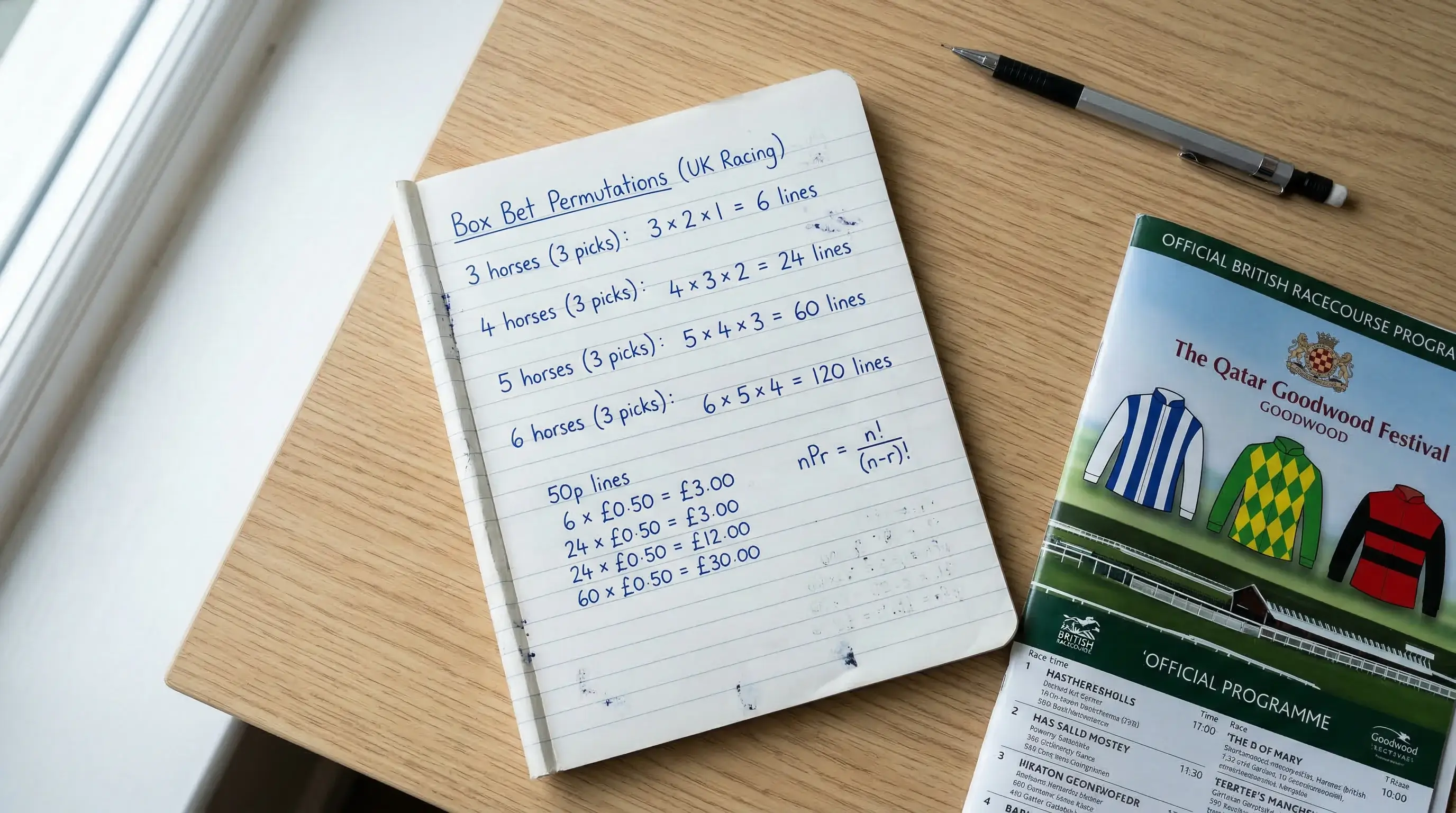
Watch the escalation. A box tricast on 7 horses at just £0.50 per line costs £105. At £1 per line, it is £210. The jump from 5 to 7 selections more than triples the tricast cost. Always calculate your total outlay before confirming.
What You Are Actually Buying: Coverage vs Field
Numbers without context are just numbers. Here is the context that matters: in a 16-runner handicap — and the BHA schedules roughly 2,300 such races per year across UK tracks — the total number of possible forecast permutations is 16 × 15 = 240. A box forecast on four horses covers 12 of those 240 combinations, giving you 5 per cent coverage of the market. That may sound thin, but if your form analysis is strong enough to isolate four genuine contenders from a field of sixteen, you are turning a 1-in-240 lottery into a 1-in-20 proposition. The maths of boxing is not about brute-force coverage; it is about concentrating your stake on the outcomes your analysis supports.
For tricasts, the total permutation space in a 16-runner field is 16 × 15 × 14 = 3,360. A box tricast on five horses covers 60 of those — 1.79 per cent. The coverage is slimmer, but the dividends are proportionally larger. The key question is not "how many combinations do I cover?" but "are my five selections more likely to fill the first three places than 1.79 per cent implies?" If the answer is yes, the box tricast has positive expected value. If the answer is no, save your money.
BoxBet · Independent Analysis
Box Bet Coverage & Dividend Calculator
Your selections
Tick the runners to box. Set each one against the market: Market means you agree with the price, +25% means you rate its chance a quarter better than the price implies.
Total outlay
–
–
Coverage of the field
Every square is one finishing order: row = winner, column = second.
Permutations you are covering
Dividend figures are modelled from the prices you enter and the takeout you set — CSF and CT dividends are declared by an industry algorithm and Tote dividends by pool size, so actual returns will differ. Nothing here is a tip. 18+. National Gambling Helpline: 0808 8020 133.
Box Bet vs Straight Bet: When Order Doesn't Matter
The straight forecast asks you to name the first two finishers in exact order. The box forecast asks you to name contenders and lets the permutations handle the order. Same race, same runners, fundamentally different propositions — and the right choice depends on how much certainty your analysis actually provides.
The Core Trade-Off
A straight forecast costs one unit stake. A box forecast on the same two horses costs two units. You pay double for the insurance of not needing to predict who finishes first and who finishes second. On paper, that sounds expensive. In practice, it is often cheap insurance.
Consider the data. Market favourites win approximately 33 per cent of UK flat races and 29 per cent of National Hunt races, according to Timeform's statistical analysis. That means roughly two-thirds of all races produce a result that defies the most obvious prediction. If you cannot reliably predict the winner of a race — and the market-wide strike rate suggests that nobody can with consistency — predicting the exact order of two or three finishers is a harder task still. The box bet acknowledges this reality and prices in the uncertainty.
Comparative Table: Straight vs Box Across Field Sizes
| Field Size | Total Forecast Permutations | Straight Forecast Odds (1 bet) | Box 3 Horses: Permutations / Coverage | Box 4 Horses: Permutations / Coverage |
|---|---|---|---|---|
| 8 runners | 56 | 1 in 56 | 6 / 10.7% | 12 / 21.4% |
| 12 runners | 132 | 1 in 132 | 6 / 4.5% | 12 / 9.1% |
| 16 runners | 240 | 1 in 240 | 6 / 2.5% | 12 / 5.0% |
| 20 runners | 380 | 1 in 380 | 6 / 1.6% | 12 / 3.2% |
When Straight Bets Make Sense
Straight forecasts have their place. In small-field Group 1 races with a dominant favourite, where the likely finishing order is well established by the market, the straight forecast offers a higher payout for a lower outlay. If a 1/3 favourite is widely expected to beat a 5/1 second-favourite, and your analysis agrees, there is no reason to pay for the reverse permutation. The straight forecast rewards conviction; the box forecast rewards range.
When Boxing Wins
Boxing wins when the finishing order is genuinely uncertain — which, in UK handicap racing, is most of the time. Large-field handicaps at Newbury, York, or Cheltenham regularly feature five or six runners at single-figure prices. In that environment, predicting exact order is closer to guesswork than analysis. The box lets you say "these four horses will fill the places" without pretending you know which one edges ahead in the final furlong. That honesty, as the cost table above shows, can be bought for as little as £12 on a four-horse forecast.
Box Forecast vs Each-Way: A UK-Specific Value Comparison
Each-way betting is the default setting of British punting culture. It is the first bet most people learn, the most commonly offered promotion, and the structure around which the entire UK odds market is built. But default does not mean optimal, and there are specific scenarios where a combination forecast delivers more value per pound staked than an each-way wager ever could.
How Each-Way Works — And Where It Leaks Value
An each-way bet is two bets in one: a win bet and a place bet. The place portion typically pays at one-quarter or one-fifth of the win odds, depending on field size and race type. If your horse finishes second or third (or fourth in larger handicaps), you collect the place part. If it wins, you collect both.
The problem is structural. Each-way place terms are set by the bookmaker, and the fractions are not especially generous. A horse at 10/1 each-way at quarter odds returns £2.50 profit on the place part per £1 staked. That is a reasonable consolation prize for a near miss — but it is not a pathway to serious returns. The place portion of an each-way bet is designed to keep you engaged, not to make you money. Over a season of betting, the cumulative drag of the bookmaker's place margin erodes your bankroll quietly and effectively.
Where Combination Forecasts Outperform
A combination forecast does not care about place terms, because it is not a place bet. It is a permutation bet — and the payout is determined by the CSF algorithm or the Tote pool, not by a fraction of the win odds. In a 16-runner handicap where the CSF dividend for a mid-priced combination might be £80–£150, a £1 box forecast on four horses costs £12 and returns that full dividend if any two of your selections finish first and second. Compare that to a £12 each-way stake (£6 win, £6 place) on a single horse at 10/1. The each-way bet returns £87 if it wins (£66 win + £21 place), £21 if it places only. The box forecast returns £80–£150 if any permutation of your four selections lands.
"The combination forecast and tricast remain underutilised products in British racing. Many punters default to each-way bets without realising that a well-structured box forecast can offer superior value in larger fields," says Alex Sherwood, racing journalist and betting analyst at Racing Post.
Each-way is the better choice in small fields with a strong fancied runner, where the place insurance has tangible value. Box forecasts are superior in competitive handicaps with ten or more runners, where the CSF dividend compensates handsomely for the permutation cost, and where a place return at quarter odds would barely cover your original stake.
The Mindset Shift
Switching from each-way to box forecasting is not just a mechanical change — it requires a different analytical approach. Each-way betting asks "will this horse run well?" Box forecasting asks "which horses will fill the places?" The first question is about a single selection's probability. The second is about the relative strength of a shortlist. If your handicapping process naturally produces ranked groups rather than single selections — and most serious form students will recognise that it does — the combination forecast is the bet type that matches how you actually think.
When to Box: Field Size, Race Type, and the Optimal Number of Selections
Knowing how box bets work is only half the equation. The profitable half is knowing when to use them — and, just as importantly, when to leave them alone. This section is built around a framework that links field size, race type, and selection count to expected value, drawing on BHA fixture data and dividend analysis.
The Field Size Framework
Field size is the single most important variable in box bet strategy. Larger fields mean more permutations in total, which means higher CSF and CT dividends — but they also mean your selections are competing against more opponents, which reduces your hit rate. The sweet spot is not the biggest field you can find; it is the field where the dividend compensates for the probability.
The BHA schedules approximately 2,300 races per year with 16 or more runners across UK tracks — the prime hunting ground for box bettors. As covered in the cost section above, a four-horse box forecast in a 16-runner field covers 5 per cent of all possible permutations, which sounds modest until you consider that your selections are form-backed rather than random. For tricasts, a box on five horses covers 60 of 3,360 possible permutations (1.79 per cent). If the average Computer Tricast dividend for a handicap is around £2,000, the expected value of a random £1 box tricast on five horses is approximately £35.70 (£2,000 × 0.0179) against a cost of £60 — negative EV on random selections, but the equation flips when your form analysis gives you a genuine edge.
Box bets are not a substitute for analysis — they are a vehicle for it. Random boxing is a guaranteed way to lose money. Informed boxing, where your selection probability exceeds the market-implied probability, is where the expected value turns positive.
Optimal Selection Count by Field Size
| Field Size | Recommended Box Forecast Selections | Recommended Box Tricast Selections | Rationale |
|---|---|---|---|
| 8–10 runners | 2–3 | 3–4 (6–24 perms) | Smaller fields = lower dividends; keep costs tight |
| 11–15 runners | 3–4 | 4–5 (24–60 perms) | Dividend potential rises; broader coverage justified |
| 16–20 runners | 4 | 4–5 (24–60 perms) | Peak zone for box value — high dividends, manageable cost |
| 20+ runners | 4–5 | Consider part-box or banker tricast | Full box tricast on 6+ runners gets expensive fast |
Race Type Matters
"When you box a tricast in a 20-runner handicap, you're essentially saying 'I can't separate these four or five horses.' The maths rewards that honesty — you're covering permutations that a straight bet ignores," observes Nick Mordin, author of the influential handicapping guide Betting for a Living. That observation has a corollary: if you can separate your selections with confidence, a straight bet offers better value than a box. The box bet is designed for uncertainty, and it is priced accordingly.
Handicaps — whether flat or National Hunt — are the natural habitat of box bets. The weights are designed to compress the finishing order, which means form analysis produces a shortlist rather than a single pick. Conditions races, Group events, and maidens are typically dominated by fewer genuine contenders, and the dividends reflect that narrower competitive spread. A CSF on a two-horse Group 1 finish might pay £8. A CSF on a competitive 16-runner heritage handicap might pay £150. The box bet earns its premium in the latter scenario.
"In my experience, the most profitable box bets come from handicap hurdles with 12–16 runners where form is reliable but the market struggles to separate the top five or six. That's where your edge is," says Tom Segal, the Racing Post's chief tipster known as Pricewise. With the spring 2026 jumps season in full swing, opportunities in this exact profile appear weekly at Cheltenham, Aintree, and Sandown.
Flat Racing vs National Hunt: How the Code Changes Your Box Bet Approach
British racing operates two distinct codes — flat racing (turf and all-weather, roughly April to October for turf, year-round on the all-weather) and National Hunt (jumps racing, predominantly October to April). Each code produces different field dynamics, different form patterns, and different box bet considerations. Treating them the same is a reliable way to misallocate your stakes.
Field Size and Dividend Potential
The UK racing calendar spans approximately 1,500 fixture days per year: around 1,000 flat days and 500 jumps days, generating roughly 9,000 flat races and 5,500 National Hunt races annually. The average field size in flat handicaps sits at 10.8 runners, while National Hunt handicaps average 9.2. That difference — just 1.6 runners — has an outsized effect on dividend potential. Larger flat fields produce more permutations, which inflates CSF and CT dividends. A 12-runner flat handicap at York offers a fundamentally different payout profile from a 9-runner hurdle at Wetherby.
For box bettors, the implication is clear: flat handicaps are the higher-dividend environment, and your staking can reflect that. A four-horse box tricast in a 14-runner summer handicap is playing for bigger payouts than the same structure in a 9-runner novice hurdle.
The Faller Factor in National Hunt
"National Hunt racing, with its smaller fields and higher attrition rate through fallers, creates a different dynamic for tricast betting. You need to factor in the non-completion rate — around 15% of runners in a chase won't finish," explains Lydia Hislop, racing correspondent for ITV Racing and Timeform.
That 15 per cent non-completion rate in chases is a double-edged sword for box bettors. On one hand, fallers thin the effective field, which can push your selections into the places even when they are not the strongest runners on form. On the other hand, if one of your boxed selections falls, unseats, or pulls up, your permutations collapse by a third or more. The practical response is to weight your National Hunt box bets toward proven jumpers with strong completion records, and to be cautious about including novice chasers or horses with a history of jumping errors.
Seasonal Strategy for 2026
The National Hunt season reaches its peak with the Cheltenham Festival in March and the Grand National meeting at Aintree in April. As of spring 2026, these fixtures offer the richest combination tricast opportunities in the jumps calendar, with the Tote's guaranteed pool products boosting liquidity across the programme. The flat turf season ramps up from late April through the Guineas meeting at Newmarket in May, with the peak box bet window — the Heritage Handicap season — running from Royal Ascot in June through the Ebor Festival at York in August.
The seasonal transition between codes is not a break in box betting opportunities; it is a shift in approach. Jumps season rewards conservative selection with an emphasis on safe jumpers and proven stayers. Flat season rewards wider boxing in big-field sprints and mile handicaps where the form book is denser and the margins tighter. Matching your box bet structure to the code in front of you is as important as picking the right horses.
Box Bet Payouts from Cheltenham, Ascot, and the Grand National
Theory is useful. Real dividends are persuasive. This section walks through payout scenarios from the UK's three marquee racing festivals, showing what box bets actually returned — and what they would have cost.
Cheltenham Festival
The Cheltenham Festival is the four-day centrepiece of the National Hunt calendar, attracting the deepest Tote pools of any UK meeting. Total Tote pool turnover across the 2024 Festival exceeded £30 million, with individual Exacta and Trifecta pools regularly reaching five-figure sums on feature races.
In competitive handicap hurdles at Cheltenham — fields of 16 to 24 runners — Computer Tricast dividends routinely land between £1,000 and £5,000. On the forecast side, CSF dividends across UK racecourses range from roughly £15 for short-priced combinations to £250 or more in large-field handicaps, with Cheltenham consistently sitting at the upper end of that spectrum. A box tricast on five horses at £0.50 per line (60 permutations, £30 total cost) that hits a £2,500 CT dividend returns £1,250 on the winning permutation. The return on investment is over 4,000 per cent, a figure that no each-way double or accumulator can match with the same level of structural coverage.
Royal Ascot
Royal Ascot's Heritage Handicaps — the Wokingham, the Royal Hunt Cup, the Britannia — regularly attract fields of 20 to 30 runners, making them prime territory for box bets. CSF dividends on these races frequently exceed £100, and CT dividends stretch well beyond £1,000.
Consider a scenario from a typical Royal Hunt Cup field. Twenty runners, a box forecast on four horses at £1 per line: cost £12. If two of your four selections finish first and second, the CSF pays somewhere between £80 and £200 depending on starting prices. At the lower end, you have a 6.7:1 return. At the upper end, 16.7:1. These are not lottery payouts — they are realistic returns from a bet that cost less than a round at the course bar.
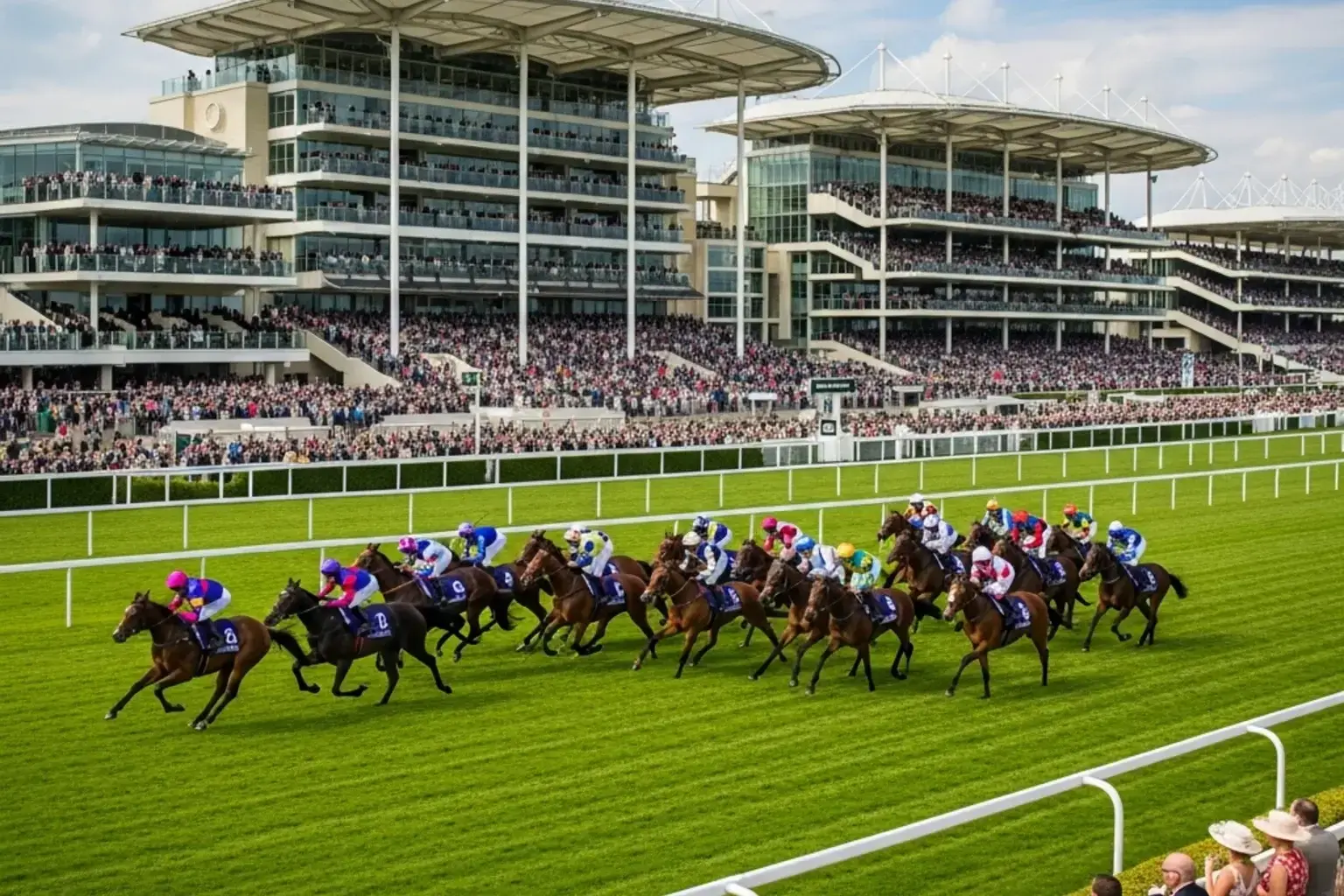
The largest recorded Tote Exacta payouts on UK racecourses regularly exceed £5,000 from a £2 stake, predominantly in handicaps with fields of 20 or more runners at Cheltenham and Ascot. The combination version of that bet — boxing three or four horses — increases your cost but also your probability of being on the right side of that dividend.
The Grand National
The Grand National at Aintree is the UK's most-watched race and, with a maximum field of 40 runners, its most unpredictable. The 2024 Grand National produced a CSF dividend that reflected the enormity of the field and the chaos inherent in a four-and-a-half-mile steeplechase with 30 fences.
In a 40-runner field, the total number of possible forecast permutations is 40 × 39 = 1,560. A straight forecast is essentially a needle-in-a-haystack bet. A box forecast on five horses covers 20 permutations — just 1.3 per cent of the total — but that coverage is concentrated on the runners your analysis has identified as contenders. For the tricast, the permutation space explodes to 40 × 39 × 38 = 59,280. A full box tricast on five horses covers 60 of those permutations, and while the coverage percentage is tiny (0.1 per cent), the CT dividend for a 40-runner field can be transformative.
The Grand National is not a race for cost-conscious boxing. It is a race for targeted boxing: three or four selections with a genuine chance of completing the course and finishing prominently, backed at modest unit stakes to keep the total outlay proportionate to the risk.
Seven Mistakes That Drain Your Box Bet Bankroll
Box betting amplifies both good decisions and bad ones. The permutation structure means every error in selection or staking is multiplied across the full number of lines. Here are the seven most common ways punters undermine their own box bet strategy.
Over-boxing. The most expensive mistake is including too many horses. A box tricast on six horses costs £120 at £1 per line. If your analysis genuinely cannot narrow the field below six contenders, the race may not be suitable for a box bet at all — or you need to consider a part-box or banker structure instead.
Ignoring total cost. Many punters focus on the unit stake and overlook the multiplier. A "small" £0.50 per line tricast on five horses is £30. On seven horses, it is £105. The bet slip shows the total, but by that point the psychological commitment has already been made. Calculate the cost before you select.
Boxing small fields. A box forecast on three horses in a six-runner race covers 6 of 30 permutations (20 per cent coverage), which sounds generous — but the CSF dividend in a small field is typically low (£15–£40). You are paying for coverage in a race where the payouts do not reward it. Save box bets for fields of ten or more runners, where the dividend potential justifies the permutation cost.
No bankroll management. The Gambling Commission's consumer survey data estimates the average net annual loss for active horse racing bettors at £200–£400. That figure assumes mixed bet types. A punter who boxes tricasts every weekend without a staking plan can blow through that average in a single month. Dedicating a fixed percentage of your betting bank to exotic bets — 10 to 15 per cent is a sensible ceiling — prevents combination bets from cannibalising your entire bankroll.
Set a session budget for box bets. "Problem gambling affects approximately 0.3% of the adult population in Great Britain, but we urge all bettors to use staking plans and set deposit limits, particularly when placing combination bets that involve multiple unit stakes," advises the Gambling Commission.
Chasing dividends. A £3,000 Computer Tricast dividend last week does not mean the next competitive handicap will produce a similar payout. CSF and CT dividends are products of starting prices, which vary enormously from race to race. Bet the process, not the last payout.
Neglecting the race type. Box bets on non-handicap races — maidens, novice events, conditions stakes — are usually poor value because the competitive spread is narrower and dividends are lower. Target handicaps, where the weights are designed to bring the field together.
Forgetting about fallers in jumps racing. If you box five horses in a National Hunt tricast and one falls at the third fence, you have effectively paid for a four-horse box while holding the cost of a five-horse box. In jumps racing, prioritise proven jumpers and consider banking your most reliable selection to reduce permutation waste.
Frequently Asked Questions
What is a box bet in horse racing and how does it relate to UK forecast and tricast betting?
A box bet is a wager that covers every possible finishing-order permutation of your selected horses within a specified number of places. In UK racing, the box bet operates through two main products: the combination forecast (covering the first two finishers in any order) and the combination tricast (covering the first three finishers in any order). If you select three horses for a combination forecast, the bookmaker generates all six possible first-and-second permutations. The term "box bet" comes from American pari-mutuel racing, where exacta and trifecta boxes serve the same function. In UK terminology, boxing two horses in a forecast is called a reverse forecast; boxing three or more is a combination forecast. Most UK licensed bookmakers and the Tote offer these products, though notably Betfair Exchange does not support direct box or combination forecast bets — punters on the exchange must construct equivalent positions manually.
How much does a box trifecta or tricast cost and how do I calculate the number of combinations?
The cost of a box trifecta (combination tricast in UK terms) is calculated using the formula: number of selections × (selections minus one) × (selections minus two) × your unit stake. Three horses generate 6 permutations; four horses generate 24; five horses generate 60; and six horses generate 120. At a £1 unit stake, boxing five horses in a tricast costs £60. Most UK online bookmakers allow minimum stakes of £0.10 per line, so the same five-horse box at 10p per line costs £6. The cost escalation is cubic — each additional horse does not add a linear increment but multiplies the existing count by a new factor. Always check the total cost on your bet slip before confirming, particularly when moving from four to five or five to six selections where the jump is significant.
Is box betting more profitable than straight or each-way betting in UK horse racing?
Box betting is not inherently more or less profitable than straight or each-way betting — profitability depends on how well you select horses and manage your stake. The mathematical advantage of box bets emerges in large-field handicaps (twelve or more runners) where form is competitive and CSF or CT dividends are high. In these conditions, a well-constructed box forecast can offer superior expected value compared to each-way bets, where place terms are set by the bookmaker at relatively unfavourable fractions. However, box bets cost more per race than a single straight forecast or each-way bet, so poor selection or over-boxing erodes your bankroll faster. The data-backed approach is to reserve box bets for races that match the optimal profile: competitive handicaps with double-digit fields, where your analysis identifies a shortlist of four or five genuine contenders. Across the broader market, favourites win only about 33 per cent of flat races and 29 per cent of jumps races, which means the majority of results favour the punter who has covered multiple outcomes rather than backed a single horse.
Sources and Further Reading
This guide draws on data and analysis from the following authoritative sources. All statistics referenced in the text are based on the most recent publicly available reports as of early 2026.
- Gambling Commission — Industry Statistics: Annual data on UK gambling turnover, gross gambling yield, and participation rates across all betting sectors including horse racing.
- British Horseracing Authority / Deloitte — Economic Impact of British Racing 2023: Comprehensive report on the economic contribution of British racing, including turnover breakdowns by bet type and employment data.
- Horserace Betting Levy Board — Annual Reports: Levy yield data, exotic bet contributions, and the financial relationship between bookmakers and British racing.
- UK Tote — Bet Types and Pool Information: Official rules and explanations for Tote Exacta, Trifecta, Placepot, and other pool products, including minimum stakes and combination bet mechanics.
- Timeform — Horse Racing Statistics: Statistical analysis of favourite strike rates, field size trends, and form-based performance metrics for UK flat and National Hunt racing.
- British Horseracing Authority — Fixtures and Results: Official UK racing calendar, fixture list data, and field size information across all tracks.
- Racing Post — Results Archive: Historical CSF and CT dividend data, race results, and form analysis resources.
