
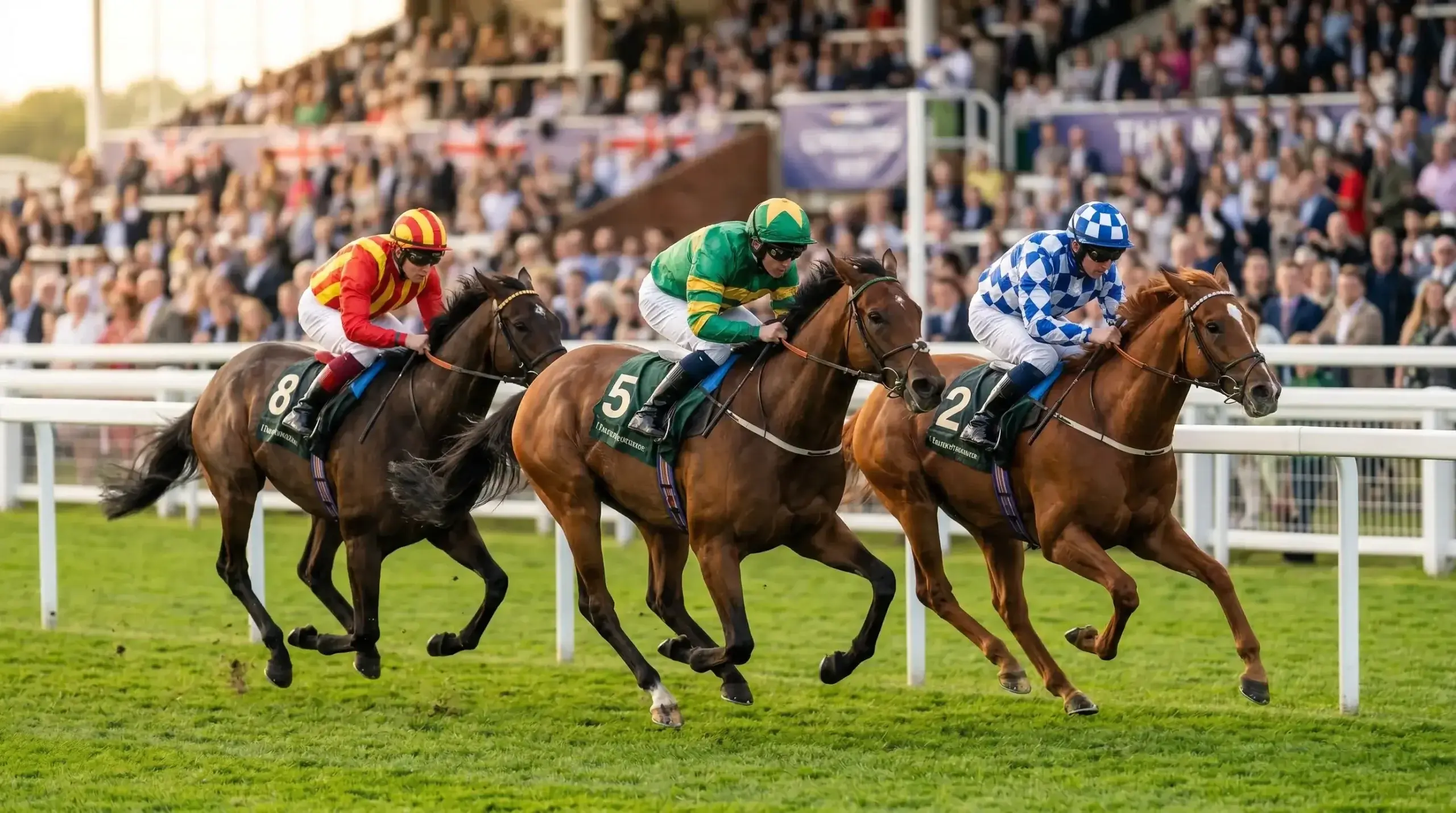
You pick three horses. They finish first, second, and third — but not in the order you expected. With a standard straight forecast, that’s a losing slip. With a box bet, it’s a winner. That single difference — covering every possible finishing order of your selected horses — is what makes a box bet in horse racing one of the most practical wagers available to UK punters, and one of the most overlooked.
The concept is disarmingly simple. Instead of predicting the exact order of finish, you select a group of horses and let the bet cover all permutations. If any combination of your selections fills the required positions — first and second for a forecast, first through third for a tricast — you collect. The trade-off is cost: more permutations mean more individual bets within the box, and the total outlay rises with every horse you add. At most UK bookmakers, the minimum unit stake starts at just 10p per line online, which keeps even a four-horse box forecast within reach of modest budgets.
If you’ve been betting each-way on British racing and never explored combination forecasts or tricasts, you’ve been walking past a door that opens onto significantly larger payouts. The rest of this guide explains exactly what’s behind it — no jargon, no assumed knowledge, just the mechanics laid bare.
How a Box Bet Actually Works: From Two Horses to Six
Start with the smallest possible box: two horses. Say you fancy Horse A and Horse B to fill the first two places in a race, but you genuinely cannot decide which will finish ahead of the other. A straight forecast locks you into one order — A first, B second — and if they swap positions, you lose. A box bet on the same two horses covers both orders: A-B and B-A. That’s two bets rolled into one, so a £1 unit stake costs £2 total.
Now add a third horse. With three selections in a box forecast, the bet covers every two-horse permutation drawn from your group. Horse A first and B second. B first and A second. A first and C second. C first and A second. B first and C second. C first and B second. That’s six individual forecasts. At £1 per line, the box costs £6. The formula is straightforward: n × (n − 1) × unit stake, where n is the number of horses you’ve selected. For three horses: 3 × 2 = 6 permutations.
The same logic scales up. Four horses in a box forecast means 4 times 3, which is 12 combinations and £12 at a £1 unit stake. Five horses: 20 combinations. Six: 30. You can see the trajectory. Each additional horse doesn’t just add a few bets — it multiplies the total, because every new selection must be paired with every existing one in both directions.
Box tricasts work identically but extend the logic to three finishing positions. The formula becomes n times (n minus 1) times (n minus 2). Three horses in a box tricast produce 6 combinations. Four horses produce 24. Five horses: 60. The numbers climb steeply, and this is the central tension of box betting — broader coverage versus higher cost. Getting that balance right is the whole game.
Here’s a practical snapshot. You’re at Newbury, looking at a 14-runner handicap hurdle. You’ve narrowed the field to four realistic contenders but can’t separate them. A box forecast on those four costs 12 times your unit stake. A box tricast costs 24 times. If you’re betting at 10p per line — the minimum at most online bookmakers — that’s £1.20 for the forecast and £2.40 for the tricast. Manageable, specific, and covering real ground.
Why the UK Calls It a Combination Forecast, Not a Box Exacta
If you’ve read anything about box bets on American-facing websites, you’ll have encountered terms like box exacta and box trifecta. Walk into a Ladbrokes on Cheltenham high street and use those phrases, and the cashier will know what you mean — but the bet slip will say something different. In British racing, the standard terminology is combination forecast (for two finishing positions) and combination tricast (for three). The word “box” is understood but informal; the official language belongs to the UK’s own betting framework.
This isn’t just a naming quirk. The UK system has its own settlement mechanisms that differ from American pari-mutuel pools. When you place a combination forecast with a traditional bookmaker, your payout is calculated using the Computer Straight Forecast, an algorithm that derives the dividend from the starting prices of the finishing horses. It’s not a pooled payout — it’s a mathematical formula applied after the race. That means your dividend doesn’t depend on how many other punters backed the same combination, which is a fundamental departure from the US model.
There’s also the Tote, the UK’s pool betting operator, which offers its own Exacta and Trifecta products. These do work on a pool basis — your payout depends on the total pool and the number of winning tickets. So in practice, a UK punter placing a “box bet” might be dealing with either system depending on which platform they use. The bet structure is the same — cover all permutations — but the way the dividend is calculated, and therefore how much you’re paid, can differ substantially between a CSF-settled bookmaker bet and a Tote pool bet.
Understanding this distinction matters more than most guides let on. A combination forecast at £1 per line settled via CSF might pay £45 on a given result, while the Tote Exacta on the same race might return £62 — or £31. The underlying bet is identical. The payout system is not.
Who Should Use a Box Bet and When It Makes Sense
The box bet suits a specific kind of punter — or more precisely, a specific kind of situation. Professional punter and former Channel 4 Racing presenter Dave Nevison put it well: “The beauty of the box bet is its mathematical simplicity. You don’t need to predict exact order — you just need to identify contenders. In a competitive handicap, that’s a much more achievable task.” That captures the appeal neatly. If you can identify which horses will be involved in the finish but not which one will lead the others home, a box bet is the right structure for your opinion.
Beginners find box bets useful because they lower the precision threshold. Picking the winner of a 16-runner handicap is hard. Picking three horses that will fill the first two places, in any order, is still hard — but it’s a meaningfully different kind of hard. You’re no longer predicting one outcome; you’re predicting a group, and the box covers the internal ordering for you. That’s a more realistic proposition for someone who studies a racecard and can separate the contenders from the no-hopers but isn’t confident enough to rank them.
Experienced bettors use box bets for different reasons. In a competitive handicap where the BHA handicapper has done a good job, the top five or six horses on form may be genuinely inseparable. Trying to rank them is guesswork dressed up as analysis. A box tricast on four or five of those horses is an honest reflection of uncertainty — and, crucially, it’s priced accordingly. The potential dividends on a box tricast in a handicap with 14 or more runners can be substantial, precisely because straight tricasts in those fields are so difficult to land.
Where box bets don’t make sense: small-field races — a five-runner conditions stakes at Ascot, for instance — where the forecast dividend will be modest and the cost of boxing eats most of the return. They also don’t suit situations where you have a strong view on the winner but less opinion on the places. In that case, a banker forecast or a simple win bet is the sharper tool. The box is built for uncertainty within a defined group, and it performs best when the group is drawn from a field large enough to generate meaningful payouts.
What Is a Box Bet in Horse Racing? A Plain-English Explanation — More on this topic at box bet horse racing.
See also Tote Exacta and Trifecta Pools.
