
The Exacta Without the Guesswork: Why UK Punters Box Their Forecasts
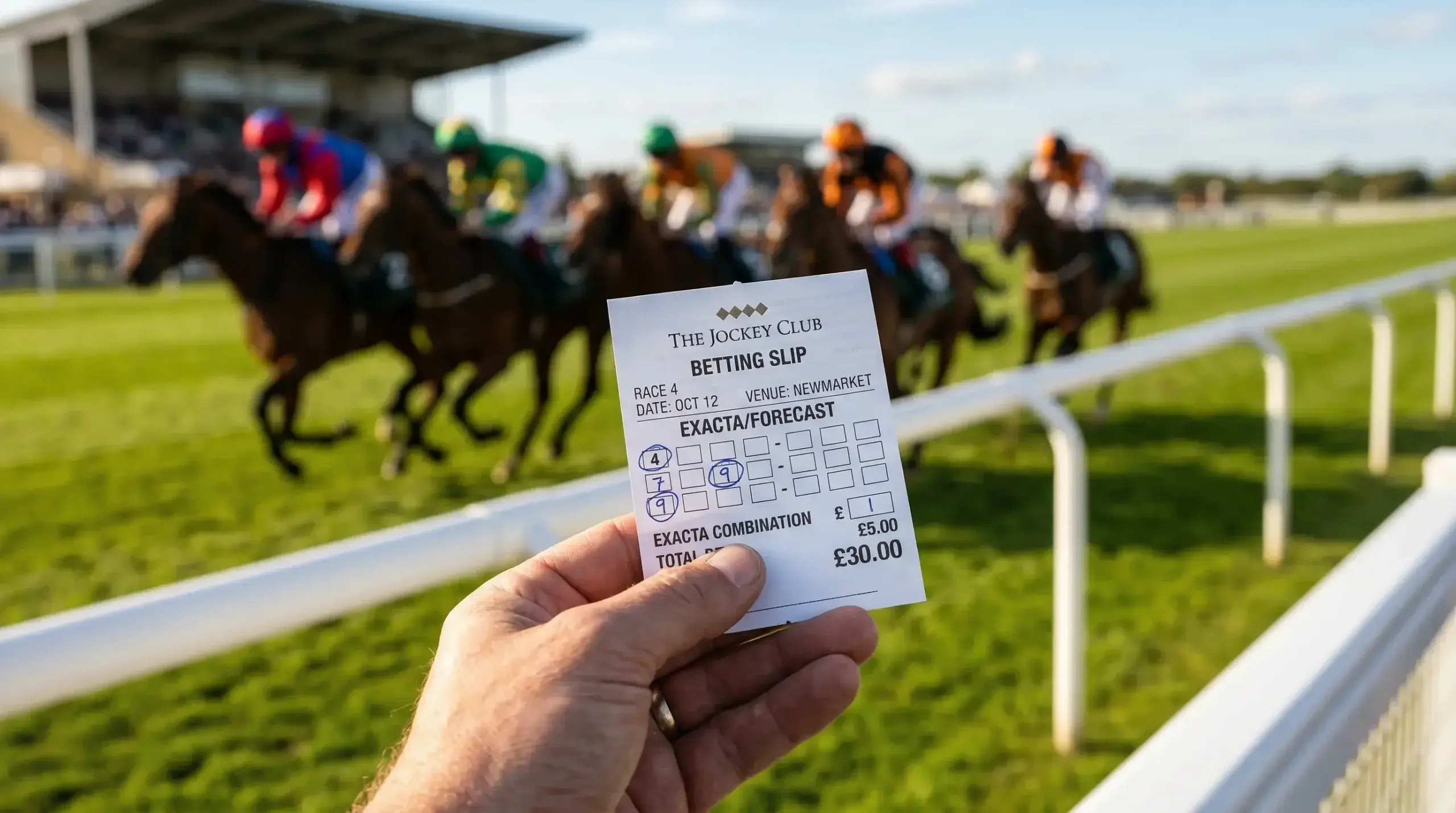
A box exacta in horse racing removes the one variable that sinks most forecast bets: the order of finish. Instead of predicting which horse crosses the line first and which finishes second — in that exact sequence — you select two or more horses and let every possible finishing order count. In UK racing, this mechanism carries a different name. Bookmakers and the Tote call it a combination forecast, and it operates on a principle so straightforward it’s remarkable how few punters use it: any order, same race, same payout potential.
The distinction between a straight forecast and a combination forecast is a single tick box on a betting slip, yet the strategic gap between the two is enormous. A straight forecast on a 16-runner handicap at Newbury gives you one shot at the correct first-second combination out of 240 possible permutations. A box exacta on three horses covers six of those permutations. On four horses, twelve. The cost scales linearly while the coverage scales meaningfully — and in competitive handicaps, where the Computer Straight Forecast dividend regularly ranges between £15 and £250 depending on field size and class, that coverage translates directly into a higher strike rate.
British racing’s exotic bet market remains surprisingly thin relative to the total handle. The Gambling Commission’s industry data shows UK horse racing betting turnover reached £4.1 billion in 2023, yet exotic and forecast bets — including combination forecasts and tricasts — account for only an estimated 8 to 12 per cent of that total, according to the British Horseracing Authority’s economic impact research. The vast majority of punters default to win and each-way bets, leaving the combination forecast as something close to an open lane on a crowded motorway.
This article breaks the box exacta down to its moving parts. You’ll see the formula that determines cost, the table that shows how selections scale into combinations, the difference between collecting from a CSF algorithm and a Tote pool, and the specific race conditions where boxing a forecast shifts from a nice idea to a mathematically sound decision. None of it requires a degree in probability — just a willingness to think beyond the each-way reflex.
How a Box Exacta Generates Its Combinations
The formula behind a box exacta is one of the simplest in betting mathematics. Take the number of horses you want to include — call it n — and multiply by n minus one. That gives you the total number of ordered pairs, each representing a unique first-second combination. Multiply that figure by your unit stake and you have the total cost.
Written out: total combinations = n x (n – 1). For a box exacta on three horses — say, selections A, B, and C — the calculation is 3 x 2 = 6. Those six bets cover A-B, A-C, B-A, B-C, C-A, and C-B. At a pound per line, the total outlay is six pounds. For four horses, the maths runs 4 x 3 = 12 combinations, costing twelve pounds at the same stake. Five horses: 5 x 4 = 20 lines. Six: 30. Seven: 42. Eight: 56.
The growth is linear in algebraic terms but feels exponential when you’re filling out a slip. Moving from four selections to five adds eight new combinations. Moving from five to six adds another ten. By the time you reach eight selections, you’re covering 56 permutations — a stake commitment that demands either very small unit stakes or very strong conviction.
Here’s how it looks across common selection sizes:
| Horses selected | Combinations | Cost at £1/line | Cost at 10p/line |
|---|---|---|---|
| 2 | 2 | £2 | £0.20 |
| 3 | 6 | £6 | £0.60 |
| 4 | 12 | £12 | £1.20 |
| 5 | 20 | £20 | £2.00 |
| 6 | 30 | £30 | £3.00 |
| 7 | 42 | £42 | £4.20 |
| 8 | 56 | £56 | £5.60 |
The 10p column matters. Most UK online bookmakers allow minimum stakes of £0.10 per line on forecast bets, which means a five-horse box exacta can be placed for just two pounds. That low floor makes it possible to box aggressively in large-field handicaps without committing a day’s bankroll to a single race.
Context helps. In a field of 16 runners — typical for a Saturday handicap at York or Newmarket — the total number of possible first-second permutations is 16 x 15 = 240. A box exacta on four selections covers 12 of those 240 outcomes, which is five per cent of the total permutation space. According to BHA fixture data, there are roughly 2,300 UK races per year with fields of 16 or more runners, mostly handicaps. Each of those represents a race where a four-horse box at 10p per line costs £1.20 and covers one in every twenty possible results. That’s not a guarantee, but it’s a far more reasonable proposition than the 1-in-240 probability of nailing a single straight forecast.
One thing the formula doesn’t tell you is which combinations are likely to pay better. A box exacta on the three shortest-priced horses in a race might cover six permutations, but the CSF dividend when two favourites fill the first two places is usually modest — often under £20. The same box that includes a 25/1 outsider alongside two fancied runners produces a very different payout profile. The formula handles cost. Selection handles value. The two don’t always point in the same direction, which is exactly why the next section — the payout mechanism — matters as much as the maths.
CSF vs Tote Exacta: Two Payout Systems, One Bet Type
Place a box exacta with a UK bookmaker and you’ll be paid according to the Computer Straight Forecast — the CSF. Place the same bet through the Tote and you’ll receive a Tote Exacta dividend. Both reward you for finding the first two finishers in any order, but the mechanisms that generate those payouts are fundamentally different, and understanding the difference is one of the clearest edges a box bettor can develop.
The CSF is an algorithm, not a pool. After a race finishes, the bookmaker’s system calculates what the forecast dividend should have been based on the starting prices of the first two finishers. It factors in the odds of both horses and the overall structure of the market. The result is a fixed figure — say, £47.62 — that represents a fair payout for a £1 straight forecast. If you placed a box exacta and the winning combination was one of your covered permutations, you collect that CSF amount multiplied by your unit stake. The key property of the CSF is consistency: it reflects the probability implied by the market at the off, regardless of how much money was bet on forecasts specifically.
“British racing’s forecast and tricast markets are fundamentally different from American exotic pools,” explains James Willoughby, a racing analyst at Timeform. “CSF is calculated by an algorithm, not by pool size, which means the payouts reflect true probability rather than crowd sentiment.”
That distinction is not academic. In a Tote Exacta pool, the dividend depends entirely on how much money flows into the pool and how that money is distributed across combinations. On a quiet Tuesday at Southwell, the Exacta pool on a six-runner novice hurdle might total £3,000. The dividend in that scenario can be volatile — a handful of large bets on one combination skews the entire payout. At the other end of the spectrum, Cheltenham Festival races and Royal Ascot feature days generate Tote Exacta pools averaging £20,000 to £80,000, providing enough liquidity for the dividend to stabilise around a figure that genuinely reflects the difficulty of finding the correct forecast.
When does the CSF pay better? Typically in smaller, less liquid fields where the Tote pool is thin. A 10-runner maiden at Lingfield on a midweek card draws minimal pool action, and the Tote dividend can dip below the CSF because too much money has been concentrated on obvious combinations. The CSF, calculated from the broader win market, tends to be more generous in these conditions because it isn’t subject to the same herd behaviour.
When does the Tote win? Primarily in large-field handicaps at major meetings, particularly when an unexpected result comes in. If the first two finishers are both unconsidered 33/1 shots in a 20-runner Ascot handicap, the CSF might return a handsome four-figure sum — but the Tote pool, where almost nobody backed that exact combination, can return even more. The Tote operates on a parimutuel basis: the total pool minus the operator’s commission is divided among winning ticket holders. Fewer winners means a bigger share of a bigger pool.
There is a practical implication for box bettors. If you’re boxing four horses in a competitive handicap at a festival, you can split your action: place part of your box through a fixed-odds bookmaker to collect the CSF, and part through the Tote to access the Exacta pool. You won’t know in advance which will pay more — no one can — but dual coverage gives you the better of two pricing mechanisms on the combinations where they overlap.
A few bookmakers now offer “best forecast odds” — comparing the CSF and Tote Exacta and paying whichever is higher. This feature is not universal and tends to appear on feature race cards rather than every race, but it’s worth checking before placing your box. One combination, two payout calculations, and no additional cost if the bookmaker runs the promotion. That’s an edge that requires exactly zero handicapping skill to exploit.
One caveat. Tote pool dividends are declared to a fixed stake — £1 for Exacta and Trifecta products. When comparing a CSF to a Tote Exacta, the units usually align directly: a CSF of £47.62 and a Tote Exacta of £52.10 are both per-pound figures. But some Tote display formats in racecourse results or on third-party sites may present dividends to a £2 unit, particularly for the Placepot. Always check the unit before assuming a direct comparison. Misreading this is more common than it should be.
Keeping Your Box Exacta Affordable: Staking Tactics
The biggest danger with a box exacta isn’t picking the wrong horses. It’s picking too many of them. Four selections at £1 per line cost £12 — manageable for most punters. Six selections at the same stake cost £30. Eight cost £56. The formula is transparent, but the spending can creep up across a full card if you’re boxing in multiple races without a staking framework in place.
Start with the unit stake. Most UK online bookmakers accept a minimum of 10p per line on forecast bets, which transforms the economics of boxing. A five-horse box exacta at 10p per line runs to £2 total. Even a six-horse box — 30 combinations — costs just £3. These micro-stakes are not trivial: the CSF dividend on a handicap can still return £100 or more per £1 unit, so a 10p line hitting at that level returns £10. Across a Saturday card with six or seven competitive handicaps, a disciplined 10p-per-line strategy keeps total expenditure under £20 while maintaining meaningful coverage.
The second lever is selection discipline. There’s a strong temptation to include “just one more” in a box, particularly in large-field handicaps where form points to six or seven plausible contenders. Resist it. Each additional horse adds progressively more combinations, and the marginal value of the extra coverage diminishes as the cost rises. A useful rule of thumb: if your total box cost exceeds the average CSF dividend for that race type, you’ve over-extended. In a Class 4 handicap at Haydock, for instance, CSF dividends typically cluster between £30 and £80. A box costing £42 (seven horses at £1) is eating into most of that range before you’ve collected a penny.
Part-boxing offers a middle path. Instead of giving all selections equal status, you anchor one horse — your strongest opinion — in a fixed position (first or second) and box the remaining selections around it. This is technically a combination with a banker, and it slashes the number of permutations. If you anchor one horse and float three others, you generate six combinations rather than the twelve a full four-horse box would produce. Cost halves. The trade-off: if your anchored horse finishes third or worse, the entire bet collapses.
The availability of box forecasts varies across licensed operators. Out of approximately 2,700 gambling licence holders registered with the Gambling Commission, only around 15 major online bookmakers offer combination forecast functionality. This is not a niche complaint — it means that if your preferred platform doesn’t support combination forecasts, you may need a second account with one that does. The Tote, Bet365, William Hill, Ladbrokes, Coral, and Paddy Power all support the feature. Betfair Exchange, notably, does not offer a direct box forecast product.
Finally, think about session budgets rather than race-by-race budgets. Set a total amount for the day’s box exacta activity — say £15 for a Saturday afternoon card — and allocate it across the races that offer the best conditions for boxing: large fields, competitive handicaps, and races where form is spread across multiple contenders. Concentrate spending on the races that suit the bet type and skip the five-runner conditions stakes where a straight forecast or a simple win bet makes more sense. The goal is to be in the right races with the right coverage, not in every race with thin coverage that barely moves the needle.
What Real Box Exacta Payouts Look Like on UK Racecourses
Numbers on a page mean less than numbers attached to a racecourse, a date, and a result. The CSF dividend range across UK racing tells a clear story about when box exactas justify their cost — and when they don’t.
At the lower end, maidens and novice races with short-priced favourites produce the thinnest forecasts. A six-runner novice hurdle at Plumpton where the favourite wins at 4/5 and the second favourite fills the runner-up spot might generate a CSF of £12 to £18. A box exacta on three horses in that race costs £6. The return is positive, but barely — and if the wrong pair fills the frame, you’ve lost more bets than you’ve won over time. This is not box territory. The field is small, the market is concentrated, and the potential reward doesn’t compensate for the additional outlay.
The middle ground is where most box exacta value lives. Class 3 and Class 4 handicaps on turf with fields of 10 to 14 runners routinely produce CSF dividends between £30 and £120. A typical Saturday handicap at York, Newbury, or Doncaster falls into this bracket. Here, a four-horse box at 10p per line costs £1.20 and stands to return between £3 and £12 — a ratio that rewards good selection without requiring a once-in-a-season upset. Over a season of disciplined boxing in these races, the hit rate and average return create a very different P&L profile than win-only betting.
At the top end sit the big-field festival handicaps. The Racing Post results archive shows that CSF dividends in handicaps with 16 or more runners regularly push past £100, with standout results reaching well beyond £250. The 2024 Grand National at Aintree — a 40-runner field, the largest in mainstream British racing — produced a Computer Straight Forecast that reflected the extraordinary difficulty of finding the first two from such a sprawling contest. In races like these, even a modest box of four or five horses at small stakes can return transformative amounts. The Tote Exacta dividend in such races can exceed £5,000 from a £2 stake when the first two home are both unconsidered in the market.
The pattern is consistent: larger fields generate larger dividends, and competitive handicaps — where no single horse dominates the market — produce the widest spread between cost and potential return. A box exacta in a five-runner Listed race at Ascot is an exercise in spending money for a small return. The same box in the Victoria Cup or the Cambridgeshire at Newmarket is a fundamentally different proposition.
One data point worth holding onto: across a full UK flat season, the average CSF in handicaps with 12-plus runners sits comfortably above £60. For a four-horse box at 10p per line — total outlay £1.20 — that average return is fifty times the stake. You won’t hit it every time. You won’t hit it most times. But the ratio between cost and median payout in the right race type is what makes the box exacta a structural bet rather than a speculative one. You’re not chasing lightning. You’re playing the maths in the races where the maths is on your side.
Five Scenarios Where a Box Exacta Beats a Straight Forecast
Knowing how a box exacta works is one thing. Knowing when to use it is what separates the informed bettor from the hopeful one. Not every race suits this bet type, and forcing it into small-field conditions or low-value scenarios is a reliable way to leak money. These five situations are where the combination forecast earns its keep.
Competitive Handicaps With 12 or More Runners
This is the core use case. A handicap with a dozen or more runners means the official handicapper has assessed these horses as closely matched. The betting market reflects that assessment: you’ll rarely see a favourite shorter than 5/1, and frequently the top of the market sits at 7/1 or 8/1. In these races, predicting the exact order of the first two is genuinely difficult. A box on four or five contenders — horses you’ve identified through form analysis as likely to run well — turns a near-impossible ordering problem into a manageable coverage exercise. The CSF dividend in this bracket typically exceeds £50, making the maths work even at relatively generous box sizes.
Two Strong Contenders With an Uncertain Pecking Order
Sometimes form study narrows the field to two horses that clearly stand out, but you cannot separate them. Both have strong recent form, both are suited by the conditions, and the market has them within a point or two of each other. A straight forecast means picking which one beats the other — a coin flip on top of the skill involved in identifying both. A two-horse box exacta costs just twice a single straight forecast and covers both orderings. In this scenario, the extra cost is minimal and the certainty improvement is maximal. It’s the cleanest application of the box principle.
Large-Field Flat Handicaps During the Summer
The UK flat season, running primarily from April to October, produces the biggest fields in British racing. Competitive flat handicaps at Newmarket, Goodwood, and York regularly attract 16 to 22 runners, and the major heritage handicaps — the Stewards’ Cup, the Wokingham, the Cambridgeshire — can field 25 or more. Average field size in UK flat handicaps is 10.8 runners, but the upper tier pushes well beyond that. These races are box exacta territory by definition. Fields are large, form is complex, and pace dynamics can shuffle the finishing order in the final furlong. A box of four or five horses at small stakes is both affordable and structurally sound.
Festival Days With Enhanced Tote Pools
Cheltenham, Royal Ascot, the Grand National meeting, and Glorious Goodwood all generate significantly deeper Tote Exacta pools than regular race days. On festival cards, the Exacta pool on a feature race can reach £50,000 or more, ensuring that dividends are liquid and reflective of genuine market difficulty. If you’re considering a box exacta on a festival handicap, placing part of the bet through the Tote exposes you to parimutuel dividends that can exceed the CSF when an unexpected combination fills the first two places. The deeper the pool, the more the Tote reward swings toward unusual results — exactly the outcomes your box is designed to capture.
Races Where You Have a View but Not a Certainty
This is the philosophical case for the box exacta, and it’s the one most punters overlook. If your form study identifies four horses that you believe will fill two of the first three finishing positions, but you don’t have a confident view on exact order, a box lets you express that opinion precisely. You’re not guessing. You’re not hedging for the sake of it. You’re translating an honest assessment of your own certainty into a bet structure that matches it. The alternative — picking one straight forecast and hoping — ignores information you already have about the difficulty of separating your contenders. The box exacta is a bet that rewards honesty about what you know and what you don’t. In any order, same race — and that’s often the most accurate reflection of what your homework actually tells you.
Box Exacta in UK Horse Racing — More on this topic at box bet horse racing.
See also Box Trifecta in UK Racing.
