
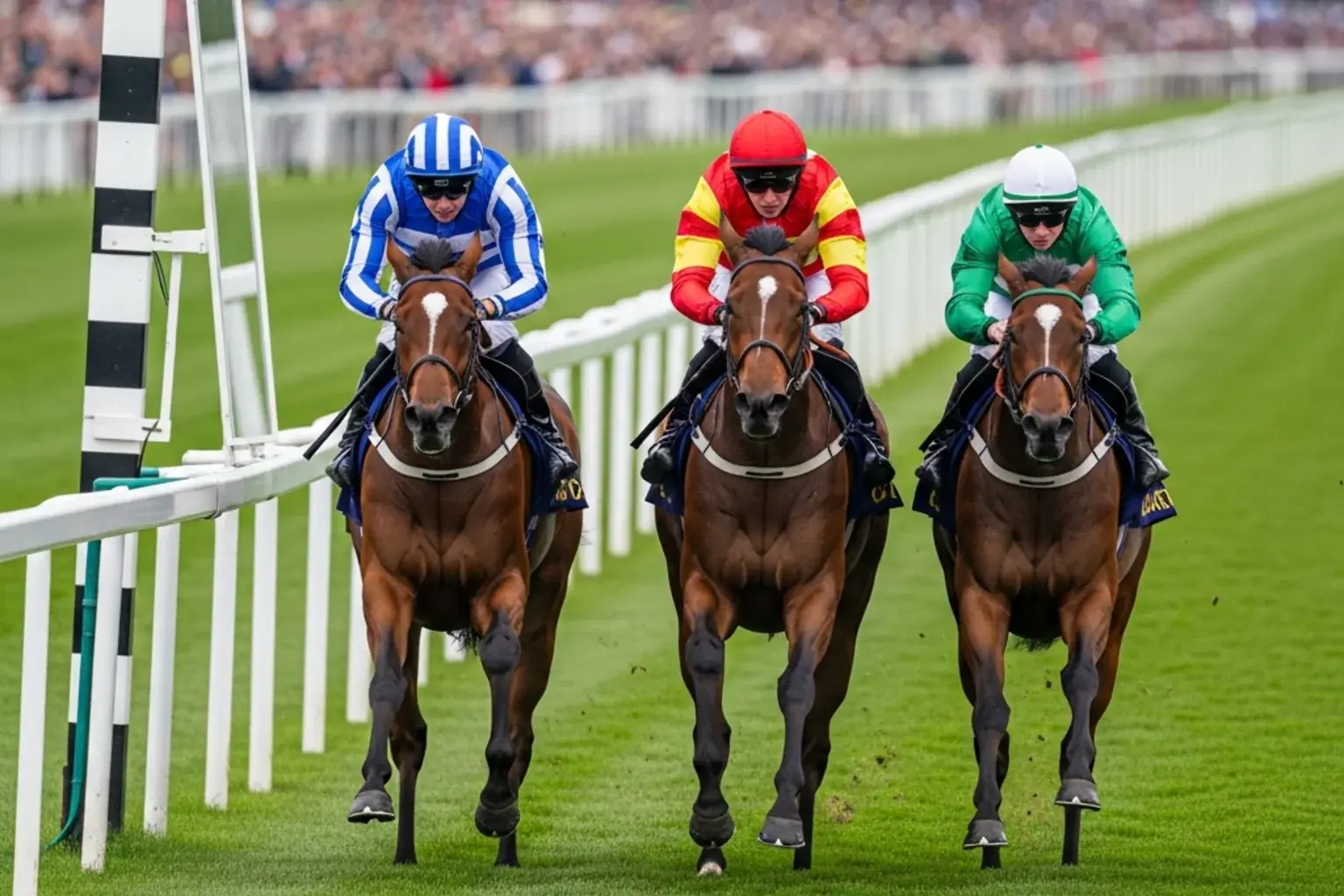
Three Horses, Sixty Combinations: What Makes the Box Trifecta Unique
A box trifecta bet explained in one sentence: you pick three or more horses to finish first, second, and third in any order, and every possible arrangement counts as a separate bet. In UK racing, the industry calls this a combination tricast, and the numbers involved are what make it both compelling and dangerous. Five horses in a box tricast generate 60 individual combinations. At a pound per line, that’s £60 committed to a single race.
The payoff, when it lands, matches that commitment. Computer Tricast dividends on UK handicap races regularly range from £500 to £5,000 and beyond, with the upper end reserved for large-field handicaps where outsiders fill the frame. Historical CT payouts on major UK races have exceeded £10,000 from a single £1 stake — numbers that put the combination tricast in a different category from standard win or each-way betting. Three places, every order — that’s the mechanism. The question is whether the cost of covering those orders justifies the potential return.
This article builds the full picture. You’ll see the formula that determines how many combinations your selections produce, a cost table running from three to ten horses, an expected value analysis that shows when the maths tips in the bettor’s favour, and practical methods for choosing which horses to include. The box trifecta is not a lottery ticket. It is a structured bet with identifiable edges — but only when the race conditions, the field size, and the staking discipline align.
The Cost Formula and a Full Combination Table (3-10 Horses)
The cost of a box trifecta follows a simple permutation formula: n x (n – 1) x (n – 2), where n is the number of horses selected. Multiply the result by your unit stake to get the total outlay. For three horses, that’s 3 x 2 x 1 = 6 combinations. For four: 4 x 3 x 2 = 24. For five: 5 x 4 x 3 = 60. The growth is cubic, and it accelerates sharply as you add selections.
This cubic scaling is what separates the tricast from the forecast. In a box exacta, moving from four to five horses adds eight combinations. In a box tricast, the same move adds 36. That’s not a marginal increase — it’s a near-tripling of the wager count. Understanding this curve before you fill in a slip is the difference between a considered bet and an expensive surprise.
The full table from three to ten selections:
| Horses selected | Combinations | Cost at £1/line | Cost at 50p/line | Cost at 10p/line |
|---|---|---|---|---|
| 3 | 6 | £6 | £3 | £0.60 |
| 4 | 24 | £24 | £12 | £2.40 |
| 5 | 60 | £60 | £30 | £6.00 |
| 6 | 120 | £120 | £60 | £12.00 |
| 7 | 210 | £210 | £105 | £21.00 |
| 8 | 336 | £336 | £168 | £33.60 |
| 9 | 504 | £504 | £252 | £50.40 |
| 10 | 720 | £720 | £360 | £72.00 |
The 10p column tells the real story for most punters. A four-horse box tricast at 10p per line costs £2.40. That’s less than most each-way bets on a single horse, yet it covers 24 distinct finishing permutations across four selections. A five-horse box at the same unit climbs to £6 — still within the range of what many punters spend on a single win bet at a Saturday meeting.
Beyond six selections, the maths starts to work against practicality. A seven-horse box at 10p costs £21. Eight horses: £33.60. Nine: over £50. These figures assume the minimum online unit stake. At £1 per line — still common among punters placing bets on course through Tote terminals — a seven-horse box costs £210. That’s a serious bankroll commitment for a single race, no matter how confident you feel about your selections.
The practical ceiling for most box tricast bettors sits at four or five selections. Three horses is the minimum and produces a clean, affordable six-combination bet that works well when you have a strong shortlist. Four gives enough coverage to absorb one wrong selection — if three of your four finish in the first three places in any order, you collect. Five is the outer edge of sensible boxing: 60 combinations is a lot of moving parts, but in a 16-runner handicap where the CT dividend can reach four figures, the cost-to-payout ratio still holds.
A note on the six-horse trap. Many bettors reason that if five is good, six must be better. It isn’t, necessarily. Moving from 60 to 120 combinations doubles the cost while adding coverage that’s increasingly marginal. Your sixth horse is, by definition, the selection you’re least confident about. If that horse’s realistic chance of finishing in the first three is below 15 per cent, adding it to the box dilutes your expected return rather than improving it. The formula tells you the cost. What it doesn’t tell you is whether that cost is justified — and that’s where expected value comes in.
Expected Value of a Box Tricast: When the Maths Says Yes
Expected value — EV — is the metric that separates structured betting from hope. For a box tricast, the EV calculation asks a direct question: given the number of combinations you’re covering, the total number of possible permutations in the field, and the average dividend for that race type, does your bet return more than it costs over the long run?
Take a concrete example. In a 16-runner handicap, the total number of possible first-second-third permutations is 16 x 15 x 14 = 3,360. A five-horse box tricast covers 60 of those permutations, which is 60 / 3,360 = 1.79 per cent of the total permutation space. If the average Computer Tricast dividend for handicaps at this field size is around £2,000, then the expected return per pound staked is £2,000 x 0.0179 = £35.70. The cost of a five-horse box tricast at £1 per line is £60. The expected return of £35.70 doesn’t cover the £60 outlay. On random selections, this is a negative-EV bet.
That negative EV on random picks is the baseline — and it’s the reason the box tricast rewards skill rather than coverage. The 1.79 per cent figure assumes all 3,360 permutations are equally likely, which they never are. A bettor who can identify five horses whose combined probability of filling the first three positions exceeds the baseline 1.79 per cent flips the equation. If your selections have, say, a 4 per cent combined probability of providing the correct tricast, the expected return rises to £2,000 x 0.04 = £80 against a £60 cost. That’s positive EV.
“When you box a tricast in a 20-runner handicap, you’re essentially saying ‘I can’t separate these four or five horses,'” observes Nick Mordin, author of Betting for a Living. “The maths rewards that honesty — you’re covering permutations that a straight bet ignores.”
The optimal number of selections shifts with field size. For fields of 8 to 10 runners, three or four horses is the efficient range — producing 6 to 24 combinations that capture a meaningful share of the permutation space without excessive cost. For fields of 14 to 20, four or five selections hit the sweet spot: enough coverage to reflect the uncertainty that large fields create, while keeping costs in a range where the average CT dividend covers the outlay with room to spare. Beyond 20 runners — the Grand National, the Cesarewitch, big-field festival handicaps — a full five-horse box at £1 per line costs £60 against a field with over 6,800 permutations. Here, a part-box or banker structure becomes more efficient than a full box.
Field size and dividend size are linked, but not linearly. A 12-runner handicap might produce an average CT of £800. A 20-runner handicap might average £3,000. But the permutation count grows much faster — from 1,320 to 6,840. The bettor’s edge isn’t in covering more combinations but in identifying the right combinations more accurately. An EV-positive box tricast in a 20-runner race doesn’t require you to be brilliant. It requires you to be slightly better than the market at identifying which five horses are most likely to fill the frame — and slightly better, in a field of 20, is an achievable target for anyone who reads the form seriously.
One practical EV checkpoint: before placing a box tricast, compare your total cost to the median CT dividend for that race type and field size. If the median dividend is three to five times your outlay, the bet has a workable risk-reward structure. If the median is less than twice your outlay, you’re paying too much for the coverage. This isn’t a perfect EV calculation, but it’s a quick filter that stops you from boxing races where the numbers don’t justify the bet.
How to Pick Which Horses to Include in Your Box Tricast
The formula determines cost. The payout system determines reward. But the selection process determines whether either of those works in your favour. Choosing which horses to include in a box tricast is not the same as finding a winner. You’re looking for contenders — horses with a realistic chance of finishing in the first three — and the criteria that identify them are broader than the criteria for a simple win bet.
Recent Form and the Finishing Position Filter
Start with finishing positions over the last three to five runs. For a box tricast, you’re not exclusively interested in horses that have been winning. A horse that has finished second, third, second, fourth, third in its last five starts may not be a compelling win bet, but it’s a horse that consistently races near the front of the field. Consistency of top-three finishes, rather than wins alone, is the first filter. In a 14-runner handicap, four or five horses will typically show this pattern. Those are your initial candidates.
Course and Distance Suitability
UK racecourses vary dramatically in character. Epsom’s camber, Chester’s tight turns, Ascot’s stiff uphill finish — these track configurations favour different running styles and physical types. A horse’s course form, specifically whether it has placed at the track before, carries more weight for a tricast selection than it might for a simple win assessment. You’re not asking “can this horse win here?” but “can this horse finish in the first three here?” — a lower bar that course familiarity helps clear. Check distance suitability alongside this: a horse proven over a mile at Newmarket is a different proposition when stepped up to a mile and a quarter at Goodwood.
Trainer and Jockey Statistics
Certain trainer-jockey combinations outperform in specific conditions. This doesn’t mean blindly following strike rates, but it does mean factoring in patterns. A trainer with a 22 per cent place rate in handicaps at a particular course, paired with a jockey who rides it regularly, produces a selection with embedded structural advantage. Resources like Timeform’s statistical tools and Racing Post’s trainer-jockey lookup make this analysis straightforward. For box tricast purposes, look for combinations with high place rates — not necessarily high win rates — at the relevant course and distance.
Pace Analysis
In large-field handicaps, the race shape often determines the result as much as individual ability. Front-runners face different challenges depending on the pace scenario. If three or four confirmed front-runners are drawn together, the early pace is likely to be strong, which favours horses that settle in behind and finish late. Conversely, a race with no obvious front-runner may be run slowly, bringing stamina into play less and giving a speed horse the chance to dictate. Identifying the likely pace scenario helps you include horses whose running style suits it. A box tricast should contain horses suited to the expected race shape, not just horses with the best recent form figures.
Going and Ground Preferences
British racing’s relationship with weather is well-documented. A horse with five wins on good-to-firm ground is not the same proposition on soft going, and vice versa. Check the going report on the morning of the race and cross-reference it with each potential selection’s ground form. Eliminate horses with poor records on the prevailing surface before finalising your box. This is the simplest filter to apply and one of the most effective at removing horses that look good on paper but won’t handle the conditions underfoot.
The selection process for a box tricast is, in essence, a funnel. Start with the full field. Filter by recent form consistency. Narrow by course and distance aptitude. Cross-reference with trainer-jockey patterns and the expected pace. Eliminate on ground preference. What you’re left with — typically three to five horses — forms your box. The process is methodical, not glamorous, and it works precisely because it avoids the common trap of including horses based on a hunch or a name you recognise from last year’s festival coverage.
Part-Box and Banker Tricast: Reducing Cost Without Reducing Coverage
A full box tricast gives every selected horse equal status: any of them can finish first, second, or third in any position. That’s the most flexible structure, but it’s also the most expensive. When your form analysis produces one standout selection alongside several contenders, a full box wastes money by treating your strongest opinion the same as your weakest. This is where the banker tricast and the part-box earn their place.
A banker tricast fixes one horse in a specific finishing position — almost always first — and boxes the remaining selections around it for second and third. If you have a strong view that Horse A will win but can’t separate Horses B, C, and D for the minor placings, a banker tricast with A fixed in first and B, C, D boxed for second and third produces six combinations instead of the 24 a full four-horse box would generate. At £1 per line, that’s £6 instead of £24 — a 75 per cent cost reduction.
The trade-off is obvious. If Horse A finishes second rather than first, you lose. A banker tricast is a bet that says “I’m confident about the winner but uncertain about the order behind.” That’s a specific claim, and it needs to be genuine. If you’re anchoring Horse A simply because it’s the favourite and you want to cut costs, you’re likely to find — after a season of results — that favourites win only around a third of the time and your banker collapses more often than it holds. A banker works when your analysis gives you a reason to expect one horse to win that goes beyond its market position: a marked improvement in form, a significant equipment change, a trainer angle that the market hasn’t priced in.
A part-box takes the concept further by assigning different horses to different positions. You might place Horse A in first only, Horse B in first or second, and Horses C, D, and E in any finishing position within the top three. This produces fewer permutations than a full box but more than a simple banker, and it allows you to express a layered opinion: “I think A wins, B is most likely to be placed, and C, D, or E could fill the remaining spot.” The calculation for a part-box is less intuitive than a full box — you can’t just apply n x (n-1) x (n-2) — and most bookmakers’ bet slips calculate it automatically once you assign positions. But understanding the principle helps you evaluate whether the structure matches your genuine assessment of the race.
Part-boxes excel in races with a clear class horse stepping down in grade. When a Group 3 winner runs in a Class 3 handicap off a lenient mark, that horse has a structurally different chance of winning compared to the rest of the field. Fixing it in first and boxing three others for the placings captures the most likely outcome at a fraction of the full-box cost. The BHA race programme creates these opportunities more often than you might expect, particularly in the early weeks of the flat season when horses return from winter breaks and the handicapper hasn’t caught up with off-season improvement.
One practical note: not all bookmakers offer the same flexibility in structuring part-box tricasts. The Tote’s combination tricast product allows full boxing but limited part-boxing through its standard interface. Fixed-odds bookmakers like Bet365 and William Hill generally support both banker and part-box configurations, though the interface varies. Check the bet slip options before committing to a structure — it’s frustrating to build a precise part-box in your head only to discover the platform doesn’t support it in the format you intended.
Biggest UK Tricast Payouts: What the Data Tells Us
CT dividends in UK racing tell a story about field size, market predictability, and the occasional afternoon when the formbook goes out the window. The range is vast. A six-runner conditions chase at Wetherby where the first three home are the three shortest-priced runners might produce a Computer Tricast of £30 to £80. A 20-runner handicap hurdle at Cheltenham where none of the first three finished in the top five of the betting returns something in a different postcode entirely.
The Racing Post’s results archive shows that CT dividends in handicaps with 16 or more runners frequently exceed £1,000 and regularly push into the £3,000 to £5,000 range. The very largest dividends — the ones that make the papers — have topped £10,000 from a single £1 unit stake. These figures are not hypothetical. They are declared results, verifiable from the day’s racecards, and they illustrate the return profile that makes the combination tricast a structurally different bet from anything else on the menu.
The Grand National provides the most extreme example. With 40 runners — the maximum field size in UK racing — the number of possible tricast permutations is 40 x 39 x 38 = 59,280. A five-horse box covers 60 of those, which is roughly 0.1 per cent. The 2024 Grand National at Aintree produced a forecast that reflected the sheer scale of the field, and the tricast followed suit. In races of this magnitude, the CT dividend routinely enters five-figure territory when the first three home include at least one horse priced at 25/1 or longer.
Cheltenham Festival, spanning four days each March, generates some of the season’s largest tricast returns. The festival’s handicap hurdles and handicap chases attract fields of 16 to 24 runners, and the competitive nature of festival racing — where every yard matters — creates genuine unpredictability in the finishing order. The Tote Trifecta pools during Cheltenham regularly reach levels that make pool dividends competitive with or superior to the Computer Tricast, particularly when the result goes against the market. Tote pool turnover across the four days of the 2024 festival topped £30 million, ensuring deep liquidity in the Trifecta product.
But the festivals aren’t the only source of big tricast returns. Midweek afternoon racing, particularly competitive Class 3 and Class 4 handicaps at Newbury, Doncaster, and Sandown, quietly produces CT dividends above £500 with reasonable frequency. These races don’t make headlines, which is precisely why they represent some of the best box tricast opportunities. The public attention — and therefore the betting volume — concentrates on Saturday feature cards. Midweek racing attracts less money, thinner markets, and greater pricing inefficiency. A box tricast in a 14-runner midweek handicap, placed at 10p per line for a total outlay of £2.40, stands to return between £50 and £500 when the correct combination includes at least one horse outside the top four in the betting. Those are workman’s returns, not lottery wins, and they’re repeatable across a season of selective boxing.
The data points toward a consistent conclusion. Box tricast dividends are highest in large-field handicaps, and they increase further when the result includes at least one horse the market underestimated. Your job isn’t to predict which races will produce the biggest CT. Your job is to box the races that consistently produce the conditions for big CTs — competitive handicaps with double-figure fields — and let the permutations do the rest. Three places, every order. When the dividend lands, the formula that felt expensive suddenly looks like a bargain.
Box Trifecta in UK Racing — More on this topic at box bet horse racing.
See also Box Bet Strategy for Horse Racing.
