
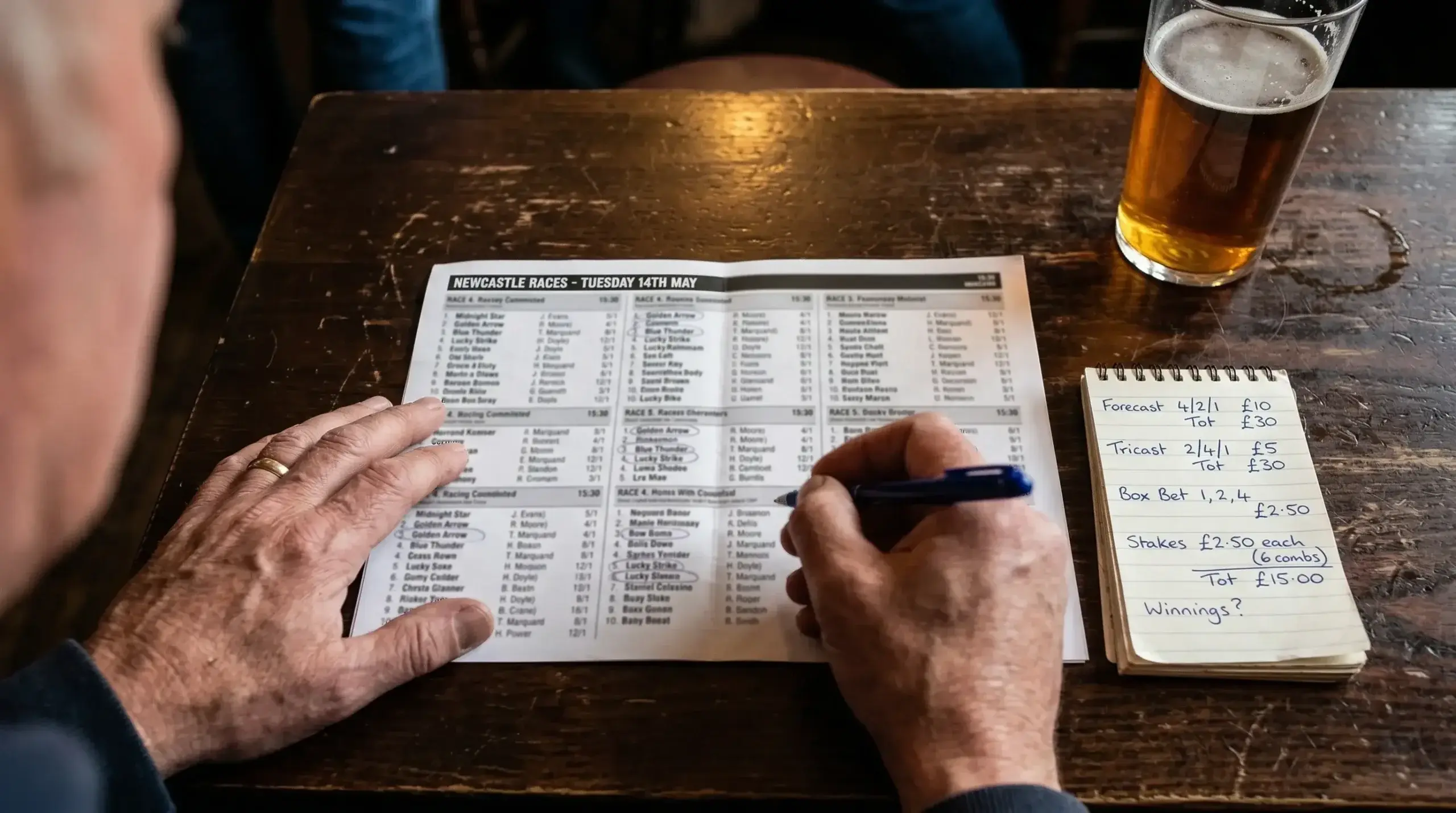
A box bet calculator for horse racing does one essential job: it tells you exactly what your combination forecast or tricast will cost before you commit a penny. That matters because box bet costs scale in a way that catches people out. Three horses in a box forecast is six bets. Four horses is twelve. Five is twenty. Miss that progression, and a casual punt becomes a surprisingly expensive one.
The formulas behind these numbers are not complicated, but doing the arithmetic in your head while standing at a Tote terminal or scrolling through a racecard on your phone is a recipe for mistakes. The tables and calculator below strip that out. Enter the number of horses, pick your unit stake, and see the total outlay instantly — for forecasts, tricasts, and the less common superfecta.
Know before you stake. That’s the principle. Everything on this page exists to make sure the cost of your box bet is a decision, not a surprise.
The Box Bet Cost Calculator
The maths behind every box bet follows a standard permutation formula. For a box forecast — where you need two horses to finish first and second in any order — the number of combinations equals n multiplied by (n minus 1), where n is the number of horses you select. For a box tricast, covering three finishing positions in any order, the formula extends to n multiplied by (n minus 1) multiplied by (n minus 2). Your total cost is simply the number of combinations multiplied by your unit stake per line.
To use the calculator, start with the bet type: forecast or tricast. Then enter the number of horses in your box — anything from 2 upward for forecasts, 3 upward for tricasts. Finally, set your unit stake. The minimum at most UK online bookmakers is £0.10 per line, though Tote terminals on racecourses typically require £1 per line. The calculator returns two figures: total combinations and total cost.
A quick reference: four horses in a box forecast at 50p per line equals 12 combinations and a £6 total outlay. The same four horses in a box tricast at 50p per line equals 24 combinations and £12. These are the numbers to have in your head before you press “place bet.”
Full Cost Tables: Forecast and Tricast at Every Stake Level
Box Forecast Costs
| Horses | Combinations | Cost at £0.10 | Cost at £0.50 | Cost at £1 | Cost at £2 |
|---|---|---|---|---|---|
| 2 | 2 | £0.20 | £1.00 | £2 | £4 |
| 3 | 6 | £0.60 | £3.00 | £6 | £12 |
| 4 | 12 | £1.20 | £6.00 | £12 | £24 |
| 5 | 20 | £2.00 | £10.00 | £20 | £40 |
| 6 | 30 | £3.00 | £15.00 | £30 | £60 |
| 7 | 42 | £4.20 | £21.00 | £42 | £84 |
| 8 | 56 | £5.60 | £28.00 | £56 | £112 |
| 9 | 72 | £7.20 | £36.00 | £72 | £144 |
| 10 | 90 | £9.00 | £45.00 | £90 | £180 |
Box Tricast Costs
| Horses | Combinations | Cost at £0.10 | Cost at £0.50 | Cost at £1 | Cost at £2 |
|---|---|---|---|---|---|
| 3 | 6 | £0.60 | £3.00 | £6 | £12 |
| 4 | 24 | £2.40 | £12.00 | £24 | £48 |
| 5 | 60 | £6.00 | £30.00 | £60 | £120 |
| 6 | 120 | £12.00 | £60.00 | £120 | £240 |
| 7 | 210 | £21.00 | £105.00 | £210 | £420 |
| 8 | 336 | £33.60 | £168.00 | £336 | £672 |
| 9 | 504 | £50.40 | £252.00 | £504 | £1,008 |
| 10 | 720 | £72.00 | £360.00 | £720 | £1,440 |
Scan the tricast table from left to right and you’ll spot the pattern immediately. Going from five to six horses doubles the number of combinations. From six to seven nearly doubles again. This isn’t linear growth — it’s factorial, and the cost curve punishes indecision. Every horse you add to your box because you “quite like it” carries a concrete price.
The forecast table grows more gently — the formula involves two factors rather than three — but it still accelerates. Jumping from four to seven horses in a box forecast triples the combination count, from 12 to 42. At a £1 unit stake, that’s the difference between a casual flutter and a meaningful investment.
Why Adding One More Horse Can Double Your Outlay
The most dangerous moment in box betting is the one where you think, “I’ll just add one more.” It feels like a small decision. It is not. Adding a sixth horse to a five-horse box tricast takes your combinations from 60 to 120 — the cost doubles in one click. Add a seventh, and you’re at 210. That single additional “just in case” horse costs you 90 more combinations at your chosen unit stake.
The reason is mathematical, not arbitrary. The tricast formula — n times (n minus 1) times (n minus 2) — means that each new horse multiplies into every existing pair, creating a cascade of new permutations. With forecasts the growth is slower but still real: six horses produce 30 combinations, seven produce 42, and eight produce 56. Every step up carries weight.
Here’s the practical consequence. Suppose you’re at a Saturday meeting, looking at a 16-runner handicap hurdle. You’ve shortlisted five horses after going through the card. A box tricast at £1 per line costs £60. You’re comfortable with that. Then you spot a sixth horse with a course-and-distance win last time out, and you think the market is undervaluing it. Adding it pushes the cost to £120. Has your expected dividend also doubled? Almost certainly not — because the field size hasn’t changed, and the CSF or CT payout for a given result remains the same regardless of how many horses you boxed. Your coverage has increased, but your return per winning combination hasn’t.
The discipline, then, is straightforward: decide on your maximum outlay first, then work backward to the number of horses your budget allows. The tables above make that exercise trivial. If your budget for a single box tricast is £30, you can box five horses at 50p per line. That’s a constraint, but it’s a useful one. It forces selectivity, and selectivity is where the value in box betting actually lives.
Three Ways to Bring the Cost Down
The most direct lever is your unit stake. Dropping from £1 to 10p per line cuts a five-horse box tricast from £60 to £6. The dividend scales proportionally — a £2,000 Computer Tricast pays £200 at 10p instead of £2,000 at £1 — but the bet is now a tenth of the price, and it still covers the same 60 combinations. For punters on a budget, or those wanting to spread their outlay across several races in an afternoon, low unit stakes are the simplest cost-reduction tool.
The second approach is tighter selection. This sounds obvious, but the tables make the case in hard numbers. Going from five horses to four in a box tricast drops the combinations from 60 to 24. That’s a 60% reduction in cost from removing a single horse. The question to ask isn’t “could this horse place?” but “is this horse more likely to place than the increase in cost justifies?” If you can’t make a strong case for the marginal selection, leave it out.
The third method is structural: use a banker. A banker tricast fixes one horse in a specific position — typically first — and boxes the remaining selections for the other places. If you’re confident that Horse A will win but unsure which of Horses B, C, D, and E will fill second and third, a banker tricast with A fixed first and B, C, D, E boxed for second and third produces just 12 combinations instead of the 60 you’d get from a full five-horse box. That’s an 80% saving with a bet that still captures your core view. The trade-off is obvious — if A finishes second instead of first, you lose — but when the opinion is there, a banker is the cost-efficient play.
Box Bet Calculator for Horse Racing — More on this topic at box bet horse racing.
See also Responsible Gambling with Box Bets.
