
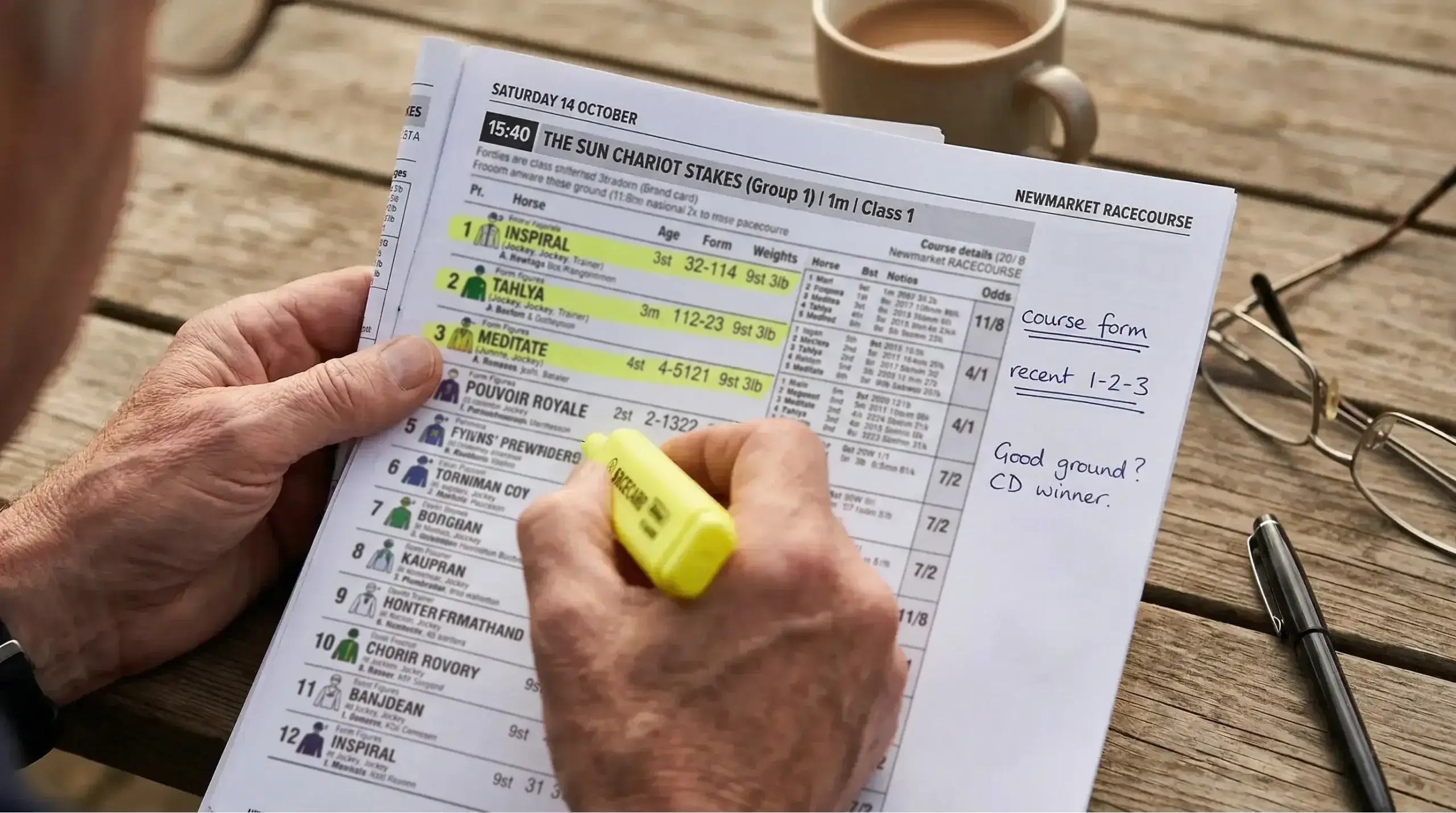
A box bet lowers the precision threshold — you don’t need to predict exact order, just identify the right group. But form analysis for box bet horse racing still matters, because the group needs to be right. Market favourites win around 33 percent of UK flat races and 29 percent of National Hunt races. That means two-thirds of the time, something other than the favourite crosses the line first. A box bet succeeds by identifying which horses from the non-favourite group are most likely to be involved in the finish, and that identification starts with the racecard.
Reading a UK racecard is a skill that looks more complicated than it is. The numbers and letters next to each horse’s name follow a standard format, and once you decode it, the racecard becomes a compressed summary of every horse’s recent career. Form narrows the field — from 16 possible selections to 4 or 5 that deserve a place in your box. The method below shows you how.
Decoding Form Figures: Numbers, Letters, and Gaps
Every horse on a UK racecard displays a string of form figures — a sequence of numbers and letters read from left to right, most recent run last. A horse showing 1-3-0-2-5 finished first, third, tenth or worse, second, and fifth in its last five runs. The hyphen separates each run. A forward slash indicates a break between seasons. A dash before the figures means the horse is returning from a layoff.
The numbers are straightforward: 1 means first, 2 means second, and so on up to 9. A 0 represents any finishing position of tenth or worse — the racecard doesn’t distinguish between tenth and last. For box bet purposes, you’re looking for horses with multiple figures between 1 and 4 in recent runs. A form line of 2-1-3-4-2 tells you this horse is consistently finishing near the front. A line of 0-0-7-0-8 tells you it isn’t.
Letters carry specific meanings. F means fell (National Hunt only). U means unseated rider. P means pulled up — the jockey stopped riding because the horse was struggling or had no chance. R means refused. B means brought down by another horse’s fall. These letters are critical for jump racing box bets: a horse showing F-P-U in recent starts has serious completion reliability issues, and including it in a box tricast carries the risk that it won’t finish the race at all.
Gaps in the form — indicated by a forward slash or a long string of dashes — tell you the horse has been off the track. A horse returning from 200 or more days absent may be fit and ready, or it may need the run. Average field sizes in UK flat handicaps sit at 10.8 runners, and in those competitive fields, a horse returning from a break carries additional uncertainty. That’s not a reason to exclude it from a box — uncertainty can produce value — but it’s a factor to weigh.
Course form appears in some racecards as a separate line. A horse that has run well at Cheltenham before — say, 1-2-3 in three previous visits — is demonstrably suited to the track. Course form is one of the most reliable predictors of future performance, particularly at courses with unusual characteristics like Epsom’s camber or Chester’s tight bends. When narrowing a field for a box bet, course form is a filtering tool that often separates the live contenders from the hopefuls.
Five Factors That Separate Contenders from the Rest
Recent Form
The last three runs carry the most weight. A horse that has finished in the first four in two of its last three outings is demonstrably competitive at its current level. Consistency matters more than brilliance for box bet purposes: you’re not looking for the horse that won once and ran badly four times — you’re looking for the one that keeps turning up near the front.
Course Form
Horses that have performed well at the specific racecourse before have a statistical edge. The effect is strongest at tracks with distinctive characteristics — Ascot’s uphill finish, Goodwood’s undulations, Haydock’s demanding ground — and weakest at flat, galloping tracks where most horses handle the layout similarly. For box bets at festival meetings, course form is a particularly powerful filter because the same courses host these events year after year.
Distance Form
A horse with proven form at the race distance is a safer inclusion than one stepping up or down in trip for the first time. Distance form is especially important in staying races, where stamina is a genuine differentiator, and in sprints, where pure speed matters more than in middle-distance races. Check whether the horse has won or placed at today’s distance before including it.
Going Preference
Some horses perform significantly better on soft ground than fast ground, and vice versa. The racecard and form book record the going for each previous run, allowing you to match the horse’s form to today’s conditions. A horse with a record of 1-2-1 on soft ground and 7-0-8 on good ground is a different proposition depending on the day’s conditions. For jump racing box bets, where the going changes frequently and affects non-completion rates, this factor can be decisive.
Trainer and Jockey Combinations
Certain trainers target specific meetings with well-prepared runners. A trainer who has a strong record at Cheltenham or York sends horses there for a reason. Jockey bookings add another signal: when a top jockey chooses to ride a particular horse over other available options, the booking implies confidence from the connections. Neither factor is sufficient on its own, but when a well-prepared horse from a course-specialist trainer has a strong jockey booked, the combination strengthens the case for inclusion.
From Sixteen to Five: A Practical Three-Step Method
Step one: elimination. Read the form figures for every runner. Immediately exclude any horse with no form at today’s distance, no form on today’s going, and no finishing positions in the first six in its last three runs. In a 16-runner handicap, this step typically eliminates five to seven horses, leaving you with nine to eleven.
Step two: ranking. From the remaining runners, rank them by course form and recent form combined. Horses with proven course form and two or more top-four finishes in recent starts go to the top. Horses with one positive factor but not both sit in the middle. Horses relying on a single decent run or returning from a long break go to the bottom. This step produces a top group of four to six horses.
Step three: selection. From your top group, select three to five horses for your box. If you’re betting a box forecast, three or four is optimal. If you’re betting a box tricast, four or five balances coverage against cost. Use the trainer and jockey factor as the tiebreaker: when two horses are evenly matched on form and course, include the one with the stronger connections signal.
The whole process takes ten to fifteen minutes per race with practice. It won’t guarantee that your box bet wins — no method can — but it shifts the probability in your favour relative to random selection, and in box betting, that shift is the difference between long-term loss and long-term viability.
Form Analysis for Box Bets — More on this topic at box bet horse racing.
See also Handicap Racing and Box Bets.
