
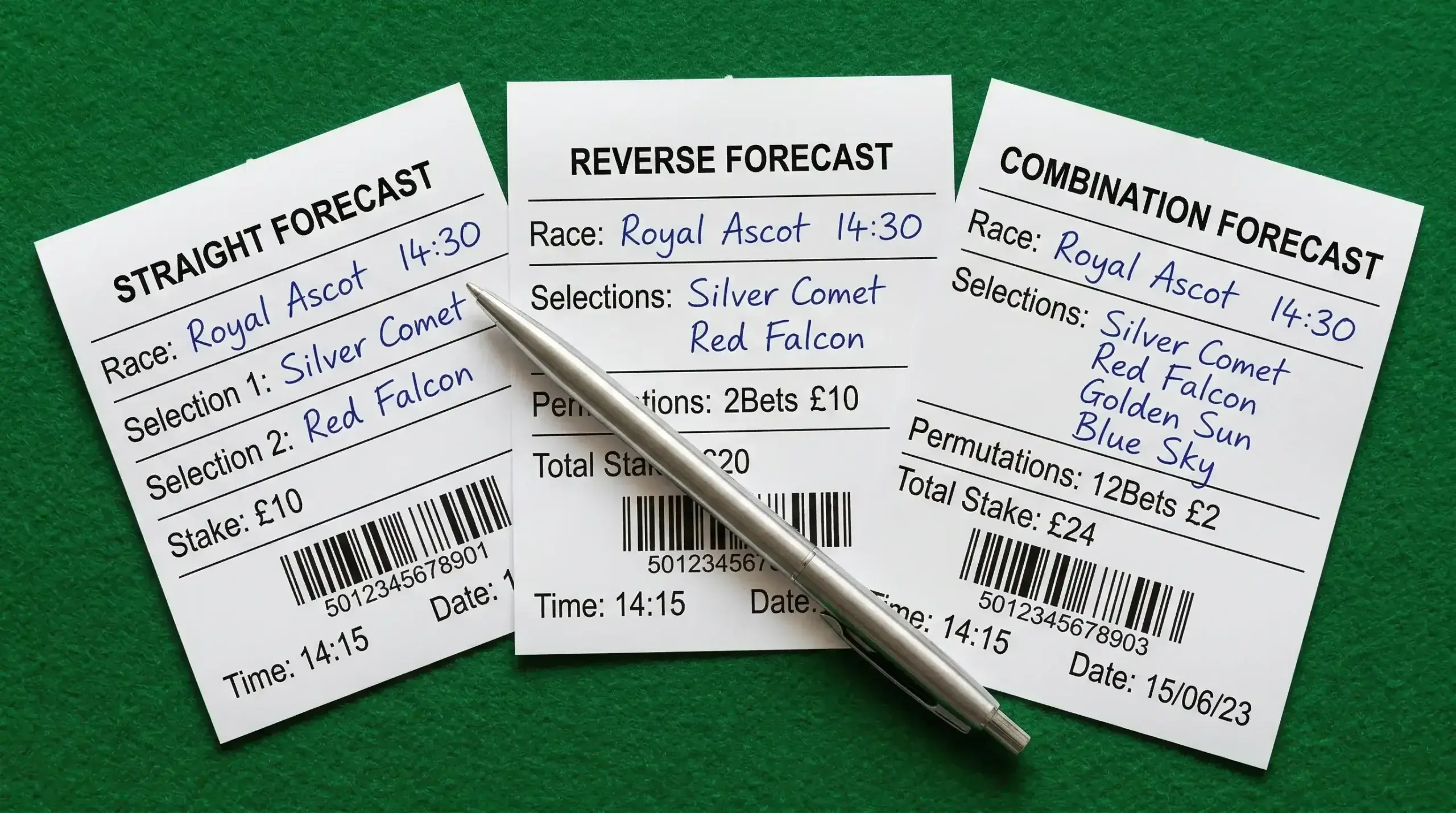
Three forecast variants exist in UK horse racing — straight, reverse, and combination — and they sound similar enough that plenty of punters use the wrong one. The differences are not trivial. A straight forecast costs one unit stake and requires you to name the exact first and second. A reverse forecast costs two unit stakes and covers both possible orders of two named horses. A box forecast bet in the UK — formally called a combination forecast — costs more again, but it covers every two-horse pairing from a group of three or more selections in both directions.
The practical gap between these structures widens sharply as the number of horses increases. With two selections, a reverse forecast and a combination forecast are functionally identical — both produce the same two permutations. Add a third horse, and the combination forecast generates six permutations where the reverse only handles two. The cost, the coverage, and the dividend potential all shift. Computer Straight Forecast dividends on UK races typically range from around £15 in small fields to well over £250 in competitive handicaps with 16 or more runners, so choosing the right forecast structure isn’t an academic exercise — it directly affects what lands in your account.
What follows is a side-by-side breakdown of all three types: what they cost, how they settle, and which race situations suit each one.
Straight, Reverse, and Combination: Three Forecast Structures Compared
Straight Forecast
The straight forecast is the purest and cheapest form. You name two horses and predict which finishes first and which finishes second. One unit stake, one bet, one outcome needed. If Horse A wins and Horse B runs second — exactly as you called — you collect. If they reverse positions, or if either horse misses the first two, the bet loses. There’s no margin for error and no additional cost. A £1 straight forecast costs £1.
The appeal is obvious: all your money rides on a single line, so the full CSF dividend applies to your entire stake. When you have a strong directional view — you’re confident the favourite will win and a particular outsider will grab second — this is the efficient bet. The downside is equally clear. In a 14-runner handicap, predicting the exact order of two horses is a 1-in-182 proposition if you’re guessing randomly. You are rarely guessing randomly, of course, but the margin between “informed” and “correct” is wider here than anywhere else in forecast betting.
Reverse Forecast
A reverse forecast is two straight forecasts bundled together. You name Horse A and Horse B, and the bet covers A first with B second, plus B first with A second. Two permutations, two units of stake, done. A £1 reverse forecast costs £2.
This structure exists for the most common scenario in forecast betting: you believe two horses will fill the first two places but won’t commit to which finishes ahead. It doubles your coverage at double the price. The dividend you receive is still the CSF for whichever order actually occurs — so if A beats B, you’re paid the CSF for A-B, not both lines. One line wins, one line loses, and you collect the winning dividend minus the total outlay.
Combination Forecast
A combination forecast — also called a box forecast — extends the reverse forecast logic to three or more horses. Select three horses, and the bet covers every possible first-second pairing from that group: A-B, B-A, A-C, C-A, B-C, C-B. Six permutations, six units of stake. Select four horses and you get twelve permutations. The formula is n times (n minus 1), where n is the number of selections.
The combination forecast is the right tool when you can identify a group of contenders but the gaps between them are too small to rank. In a race with a cluster of similarly rated horses, this is a common and honest position to hold. The cost rises with each additional horse, but so does the net you’re casting. A four-horse combination forecast in a handicap with 16 runners covers 12 of the 240 possible first-second permutations — roughly five percent of all outcomes — at a cost of twelve unit stakes.
When Two Horses Make Reverse and Combination Identical — and When They Don’t
This trips people up, so it’s worth being explicit. If you select exactly two horses, a reverse forecast and a combination forecast produce the same bet: two permutations covering both possible orders. The cost is identical, the coverage is identical, and the result is identical. There is no reason to prefer one term over the other when you’re working with two selections. Some bookmaker interfaces label the same bet differently — Bet365 might call it “reverse forecast” while another site says “combination forecast” — but the underlying structure is the same.
The divergence begins at three horses. A reverse forecast, strictly defined, only covers two named horses in both orders — two permutations. A combination forecast on three horses covers all six permutations of those three horses across two finishing positions. You cannot get six-permutation coverage from a reverse forecast. The reverse is a two-horse tool; the combination is a multi-horse tool. If you want to cover three or more horses in forecast positions, the combination is the only standard structure available.
Where this matters practically: suppose you’re looking at a Saturday handicap at York and you’ve shortlisted three horses — a pace-setter, a stalker, and a closer — with no strong view on which strategy will prevail. A reverse forecast on just two of them forces you to drop one. A combination forecast on all three costs six units but covers every pairing. The extra four units of stake buy you meaningfully broader coverage, and in a race where the CSF dividend might be £80 or more, that £4 outlay at £1 per line looks proportionate.
For four or more horses, the question is no longer “reverse or combination?” — it’s “how many horses can I justify boxing given the cost?” The reverse forecast becomes irrelevant at this point. It’s a two-horse device, and the moment you want three or more selections in the mix, the combination forecast is the only standard bet type that covers the full permutation set.
How CSF Dividends Are Calculated and Why They Don’t Follow Pool Logic
Every time you place a forecast with a traditional UK bookmaker — whether straight, reverse, or combination — the payout is determined by the Computer Straight Forecast. The CSF is not a pool. No money from other punters goes into a pot. Instead, an algorithm uses the official starting prices of the first and second finishers to derive a dividend that approximates what a theoretical fair pool would have returned.
The algorithm weighs the finishing horses’ SPs in a formula designed to reflect how likely that exact outcome was. If the favourite wins and the second favourite runs second, the CSF will be low — often in the £10 to £20 range for a £1 stake. If two outsiders fill the places, the same £1 stake might return £200 or more. The crucial point is that CSF dividends are consistent regardless of how many punters backed the same result. In a Tote pool, popular combinations pay less because the pool is split among more winning tickets. With CSF, your neighbour’s bet has no effect on yours.
This has a direct implication for box forecast punters. Because the CSF dividend is fixed by the algorithm for a given result, your decision about how many horses to box affects your cost but not your payout per winning line. If you box four horses and the winning combination returns a CSF of £85, you receive £85 per unit stake on the winning line regardless of whether you had 12 permutations running or just one. The other 11 lines lose. Your profit is the winning dividend minus the total outlay — in this case, £85 minus £12 equals £73 at a £1 unit stake.
This consistency makes forecasts with fixed-odds bookmakers slightly more predictable than Tote pool bets, where the dividend fluctuates based on pool size and the number of winners. It also means that the CSF is the benchmark against which combination forecasts should be evaluated. If the average CSF dividend in races matching your target profile — say, handicaps with 14 or more runners — sits around £80 to £120, and your box forecast costs £12, the expected return per winning bet is comfortably positive. Whether you win often enough to be profitable overall depends on the quality of your selections, not the mechanics of the payout system.
Box Forecast Bet in the UK — More on this topic at box bet horse racing.
See also A Brief History of Forecast and Tricast Betting in British Horse Racing.
