
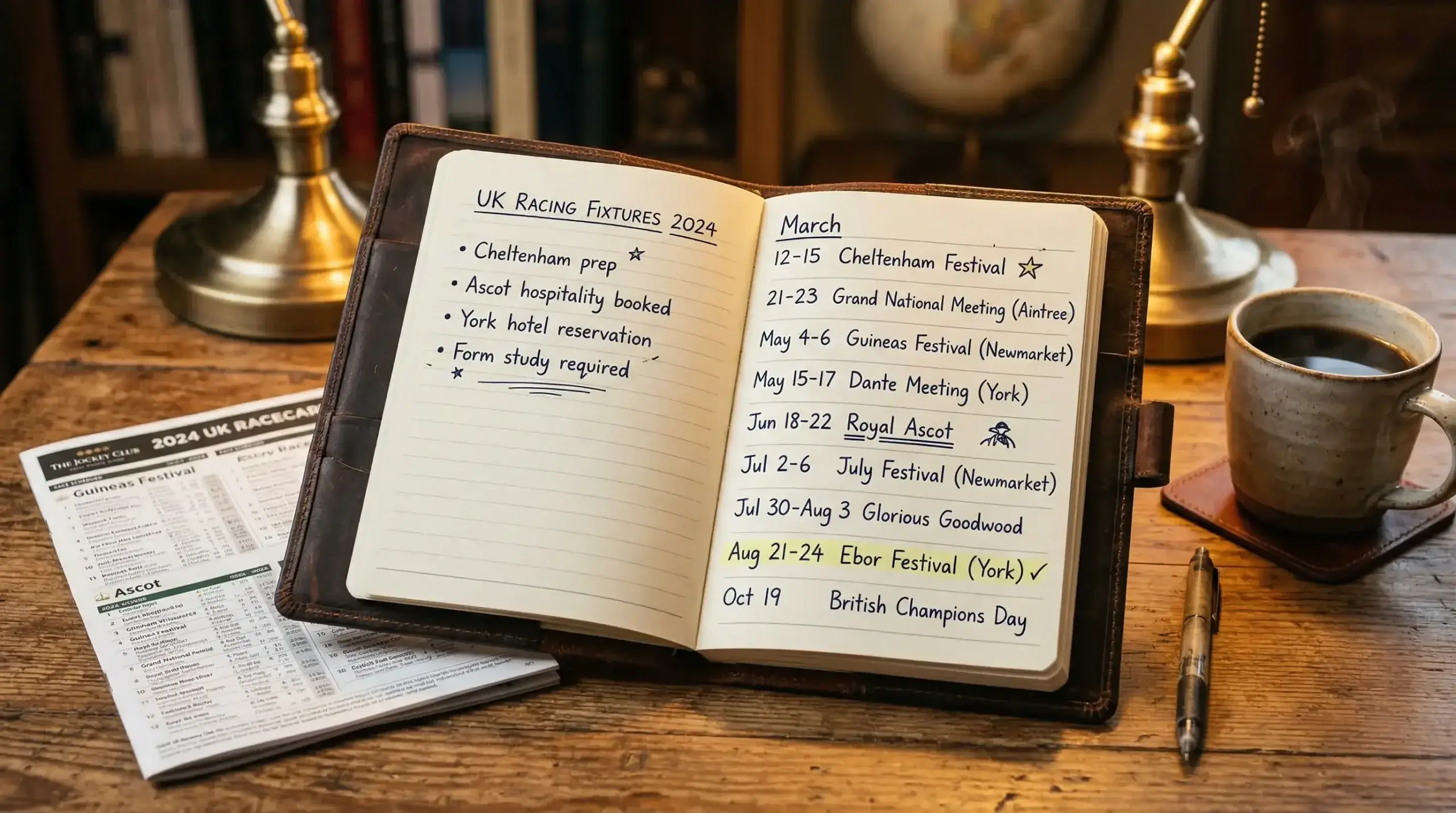
The UK horse racing calendar for box bet planning runs twelve months a year, but box bet opportunities are not distributed evenly. The BHA oversees approximately 1,500 days of racing annually — roughly 1,000 flat days and 500 National Hunt days — producing around 9,000 flat races and 5,500 jump races. The large-field handicaps that suit combination forecasts and tricasts cluster in specific windows, and knowing when those windows open is the difference between a year of aimless punting and a year of targeted, budgeted box betting. Box bets are seasonal — plan accordingly.
The calendar below maps each month by its dominant code (flat, jumps, or mixed), its typical field sizes, its key fixtures, and its box bet suitability. Tote forecast and tricast transaction volumes grew 14 percent year on year in the 2023/24 financial year, reflecting increasing interest in combination bets — and the savviest of those bettors concentrate their activity in the months where the racing calendar gives them the most to work with.
January to December: Your Box Bet Year at a Glance
January
Jump season in full swing. All-weather flat racing continues at Kempton, Lingfield, Wolverhampton, Chelmsford, and Newcastle. NH fields are moderate — 8 to 12 runners in handicaps. The ground is often heavy, increasing non-completion rates in chases. Box bet suitability: moderate. Target handicap hurdles where fields reach 12 or more and the ground isn’t extreme. All-weather handicaps offer smaller dividends but more predictable form.
February
The Cheltenham trials take centre stage at meetings like Newbury, Ascot, and Haydock. These trial meetings feature competitive handicaps with large fields as trainers give their Festival hopefuls a final prep run. Box bet suitability: good. Several Saturdays produce handicap hurdles and chases with 14-plus runners and strong form to analyse.
March
Cheltenham Festival — the single best week of the year for NH box bettors. Four days, 28 races, with handicap fields reaching 20-plus runners. Tote pools at their deepest for the jumps code. Away from Cheltenham, the flat season begins in embryonic form at Doncaster with the Lincoln meeting. Box bet suitability: excellent for Cheltenham handicaps, limited elsewhere.
April
The Grand National at Aintree — 40 runners, maximum variance. The flat turf season opens properly at Newmarket’s Craven meeting. Mixed month: the tail end of the jump season overlaps with the early flat. Field sizes on the flat are still building. Box bet suitability: excellent for the Grand National and Aintree’s supporting handicaps. Moderate for early flat handicaps.
May
The flat season hits its stride. Chester, York’s Dante meeting, and Newmarket’s Guineas festival all feature strong supporting handicaps with fields of 12 to 16 runners. The jump season winds down to its final meetings at Sandown (bet365 Gold Cup). Box bet suitability: good and rising. Flat handicap fields are growing, and the first Saturday feature handicaps of the turf season appear.
June
Royal Ascot — the flat’s premier meeting. Heritage handicaps (Wokingham, Royal Hunt Cup, Buckingham Palace) attract fields of 20 to 30 runners. Tote pools peak for the flat code. Away from Ascot, the flat calendar is dense with mid-tier handicaps at courses across the country. Box bet suitability: excellent. The highest volume of big-field flat handicaps in the year.
July
Glorious Goodwood and Newmarket’s July meeting. Both feature large-field handicaps on turf in peak condition. Sprint handicaps over five and six furlongs attract the biggest fields of the season. Box bet suitability: excellent. July and June together represent the optimal two-month window for flat box betting.
August
York’s Ebor meeting dominates. The Ebor Handicap itself — a staying handicap over a mile and three-quarters — is one of the most competitive handicaps on the flat calendar. Newmarket and Goodwood continue to produce large-field Saturdays. Box bet suitability: good. Field sizes remain strong through August before the autumn taper begins.
September
The flat season’s back end. Doncaster’s St Leger meeting and Newbury’s autumn card feature decent handicaps, but field sizes begin to shrink as the weather changes and horses are put away for the winter. The jump season starts to rebuild at smaller courses. Box bet suitability: moderate. Selective opportunities on Saturday cards, but the peak has passed.
October
The final act of the flat turf season: Champions Day at Ascot and Newmarket’s autumn meetings. Champions Day includes the Balmoral Handicap — a mile handicap with a typically large field — alongside the Group 1 races. The jump season begins in earnest at Cheltenham (October meeting), Chepstow, and Wetherby. Box bet suitability: moderate to good. The transition month offers opportunities on both codes.
November
Jump season takes over. Cheltenham’s November meeting (including the BetVictor Gold Cup — a valuable handicap chase with big fields), the Betfair Chase at Haydock, and early-season handicap hurdles provide the first major NH opportunities. Box bet suitability: good. Handicap hurdle fields are building, and the trainers’ intentions for the Cheltenham Festival are starting to become clear.
December
Christmas racing is the busiest period for NH meetings. Kempton (King George meeting), Leopardstown, and the major Christmas cards at Wetherby, Chepstow, and Newbury all feature handicaps with large fields. The Boxing Day and New Year cards are among the best-attended meetings of the year, which drives up Tote pool sizes. Box bet suitability: good to excellent. The Christmas window offers concentrated NH handicap action with enhanced pool liquidity.
Three Peak Periods for Box Bettors
The calendar condenses into three windows where box bet conditions are at their best, and budgeting should weight these periods accordingly.
The first is Cheltenham in March. Four days, multiple handicaps per day, Tote pools at their NH maximum, and fields that routinely exceed 16 runners. If you allocate a fixed annual budget to box betting, Cheltenham deserves the single largest share of your jump-season allocation.
The second is the Royal Ascot and summer flat window from mid-June through late July. Six weeks of large-field flat handicaps on prime turf, with Tote pools at their annual peak and CSF dividends reflecting the difficulty of predicting finishing orders in sprints and mile handicaps with 20-plus runners. This is the deepest water in the entire calendar for flat box bettors.
The third is the Christmas jumps programme from Boxing Day through New Year’s Day. Multiple meetings per day, strong Tote liquidity driven by the holiday racing audience, and competitive handicap hurdles and chases with full fields. The volume of opportunities across just seven or eight days makes December’s final week a compressed version of the summer flat window, but for jump racing.
Between these peaks, box betting continues — but selectively. Target Saturday feature handicaps, monitor field sizes in advance through the BHA’s fixture list, and keep your unit stakes lower during the quieter months when field sizes don’t justify the same outlay. The calendar rewards planning. Give it the attention it deserves, and your box bet year takes shape around the fixtures that actually produce the dividends worth chasing.
One practical exercise: at the start of each month, review the upcoming fixtures and flag the meetings with the most handicap races scheduled for fields of 12 or more. The BHA publishes fixture details well in advance, and the number of declared runners becomes available five days before each meeting. Build a simple monthly target list — three to five meetings where you plan to place box bets — and let the rest of the calendar pass without committing stakes. Selectivity, applied across the whole year, is the single most important discipline in box betting. The calendar tells you where to be selective. The rest is form analysis and nerve.
UK Horse Racing Calendar for Box Bettors — More on this topic at box bet horse racing.
See also Box Forecast Bet in the UK.
