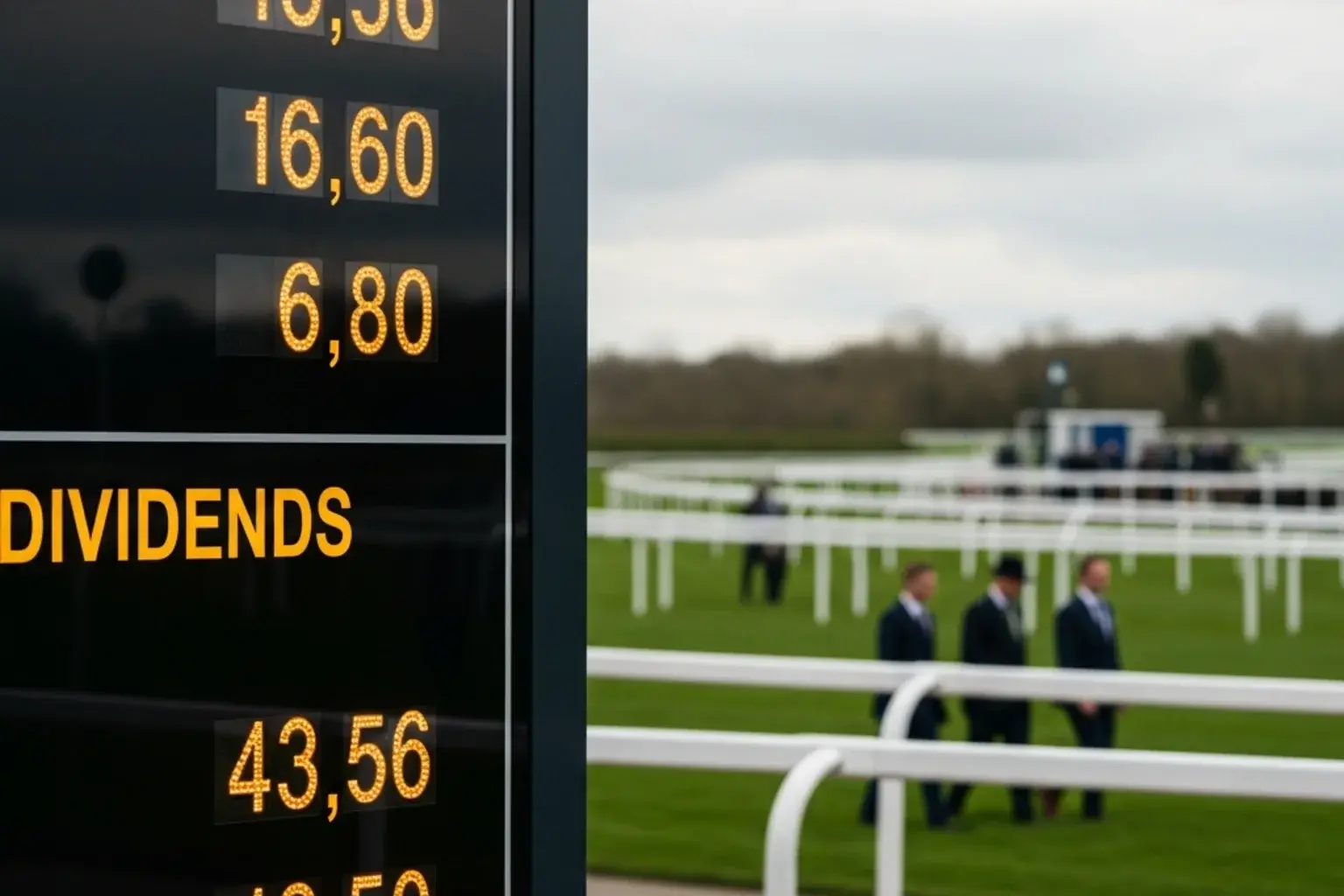
When you place a win bet at 10/1, you know exactly what you’ll be paid if it wins: £10 for every £1 staked. Box bet odds explained in the same terms would be convenient, but it doesn’t work that way. A box bet has no fixed odds. There is no number on the slip that tells you what you’ll receive. The dividend — the payout per £1 unit stake — is calculated after the race finishes, based on either an algorithm or a pool, and it can vary by hundreds of pounds depending on which of your selections fills the places and at what starting price.
This isn’t a design flaw. It’s a feature of the bet type that, once understood, actually gives you more information than a fixed-odds wager. The dividend comes after the finish, and it’s determined by the difficulty of the result. Easy results pay little. Difficult results pay a lot. Your job as a box bettor is to position yourself on the right side of that spectrum — selecting horses that are more likely to fill the places than the market suggests, in races where the resulting dividend will be large enough to justify the permutation cost.
Why There Are No Pre-Race Odds for Forecasts and Tricasts
Win bets and each-way bets are settled at a price that is either taken at the time of the bet (fixed odds) or determined at the off (starting price). Either way, the bettor knows the mechanism: the price times the stake equals the return. Forecast and tricast bets operate differently because they settle on results — specific finishing combinations — rather than on individual horse prices.
When you place a combination forecast, you’re not backing a horse to win at a given price. You’re backing a pair of horses to finish first and second in some order. The bookmaker doesn’t quote odds on that combination because the number of possible combinations in a race with 16 runners is 240, and pricing each one would be impractical. Instead, the industry uses post-race settlement methods: the Computer Straight Forecast for bookmaker bets and the Tote pool dividend for pool bets.
The CSF takes the starting prices of the first and second finishers and runs them through a formula that estimates what a fair dividend would be for that outcome. The formula weighs the improbability of each horse finishing in its position based on its SP. A 2/1 shot winning with a 5/1 shot second produces a lower CSF than a 20/1 shot winning with a 14/1 shot second, because the latter outcome was far less likely according to the market. The Tote pool works differently — dividing the net pool among winning tickets — but the principle is the same: payout reflects difficulty.
For box bettors, this means you cannot know your exact return before the race. What you can know is the range. And ranges, for anyone who has studied them, are remarkably consistent by race type.
Four Factors That Determine Your Box Bet Dividend
The Starting Prices of the Placed Horses
This is the dominant factor. CSF dividends on UK races typically range from £15 to £250 for a forecast, with the lower end reflecting results involving short-priced horses and the upper end reflecting results where outsiders fill the places. Computer Tricast dividends range from roughly £500 to £5,000 or more for handicap races. In both cases, the SP of each placed horse is the primary input. The longer the prices, the higher the dividend.
The Number of Runners
Field size affects dividends indirectly. More runners generally mean a wider spread of SPs, which increases the likelihood of a long-priced horse filling a place position. A 16-runner handicap produces higher average CSF dividends than an 8-runner race, not because of a mechanical adjustment in the formula, but because the larger field is more likely to generate a result involving at least one horse at a bigger price.
The Number of Favourites in the Places
When the market favourite wins and the second favourite runs second, the CSF is at its lowest — sometimes as low as £5 to £15. Every place position occupied by a longer-priced horse pushes the dividend higher. A tricast where the favourite wins, a 10/1 shot is second, and a 20/1 shot is third will pay substantially more than a tricast where the top three in the market fill the frame in order. Box bettors who include at least one or two horses outside the top four in the market are positioning themselves for higher dividends when those horses run into the places.
The Settlement Method: CSF vs Tote Pool
The same result can pay different amounts depending on whether the bet is settled via CSF or via the Tote pool. Popular results — where many punters backed the winning combination — tend to pay less through the Tote (because the pool is split among many winners) and more through the CSF (because the algorithm is indifferent to how many people bet). Unpopular results tend to pay more through the Tote (because few winning tickets share the pool) and sometimes less through the CSF. This dual-system feature of UK racing means that the platform you choose for your box bet can meaningfully affect your payout.
Can You Estimate Box Bet Payouts Before the Race?
Not precisely. But you can estimate usefully. The CSF dividend for a race is primarily a function of the SPs of the placed horses, and SPs are broadly correlated with pre-race market prices. If the forecast market suggests the favourite at 3/1 and the second favourite at 5/1 are likely to dominate, you can anticipate a CSF in the £15 to £30 range. If your selections include a 12/1 shot and a 16/1 shot, and both are live in a 16-runner handicap, a CSF in the £100 to £200 range is realistic if they fill the first two places.
Historical averages provide useful benchmarks. For flat handicaps with 12 or more runners, the median CSF in 2024 and 2025 sat around £60 to £80. For National Hunt handicap hurdles with similar field sizes, the median was slightly higher — £70 to £100 — reflecting the greater volatility of jump racing. Computer Tricast medians for the same race types were roughly 10 to 20 times the CSF: £800 to £1,500 for competitive handicaps.
These benchmarks let you make a rough pre-bet calculation. If the median CSF for your target race type is £70, and your four-horse box forecast costs £12, you need to land approximately one in six box bets to break even over time. That’s a useful framing: it tells you how selective you need to be and how often you can afford to miss. The dividend comes after the finish, but the planning can — and should — happen before you place the bet.
One further tool: bookmaker websites and racing data services publish historical CSF and CT dividends for every race. Reviewing the last 20 results for a specific race type — say, Class 3 handicap hurdles with 14 or more runners — gives you a distribution of actual dividends that grounds your expectations in data rather than hope. If the median CT is £1,200 and your five-horse box costs £60, you know the maths works in your favour when you land. If the median CT is £300 and the same box costs £60, the margin is thinner and the selection pressure higher. The numbers aren’t unknowable. They’re just deferred.