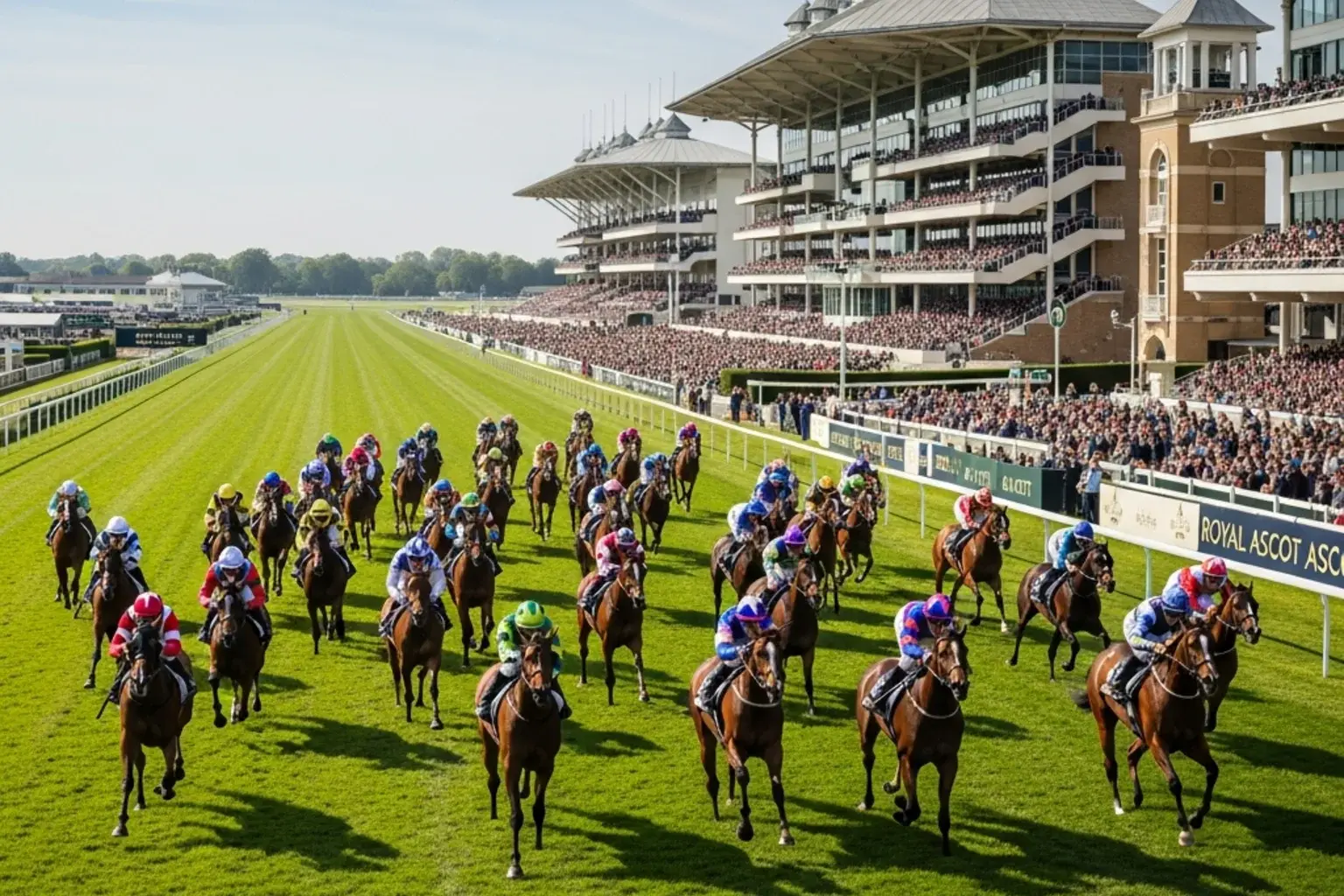
Royal Ascot runs five days in mid-June, mixing the highest level of flat racing with some of the largest, most competitive handicap fields of the year. That duality makes it both the most glamorous and the most strategically interesting meeting for box bet punters. The Group 1 races — the King’s Stand, the Queen Anne, the Gold Cup — attract small fields of six to twelve elite performers where forecast dividends are modest and box bets offer limited value. The heritage handicaps — the Wokingham, the Royal Hunt Cup, the Buckingham Palace Stakes — attract 20 to 30 runners, with CSF dividends that routinely exceed £100 and tricast dividends that push into four figures. Royal Ascot is the Flat’s richest boxing ground, but only if you know which races to target.
Average field sizes in UK flat handicaps sit at around 10.8 runners across the season. At Royal Ascot, the heritage handicaps comfortably double that average, placing them in the top tier of box bet opportunities on the entire racing calendar.
The Heritage Handicaps: Wokingham, Royal Hunt Cup, and Buckingham Palace
Three races define Royal Ascot for box bet punters, and each has a distinct profile.
The Wokingham Stakes
Run over six furlongs on the Saturday, the Wokingham is the sprint handicap jewel of the meeting. Fields regularly exceed 25 runners, occasionally reaching 30. The race is run at a furious pace, with the field often splitting into two or three groups across the wide Ascot straight. This structural chaos is exactly what box bettors need: the finishing order is heavily influenced by the draw, pace, and how the race unfolds, making it extraordinarily difficult to predict the exact first two or three. CSF dividends in the Wokingham range from £60 to well over £200 depending on the SPs of the placed horses. Computer Tricast dividends have exceeded £3,000 in years where three outsiders fill the frame. A five-horse box tricast at 20p per line costs £12. Against a potential CT of £2,000 or more, that’s asymmetric risk at its finest.
The Royal Hunt Cup
Run over a straight mile on the Wednesday, the Hunt Cup typically attracts 20 to 28 runners. It’s a mile handicap, which means the tactical dimension is significant — front-runners, stalkers, and closers all have viable strategies. The form is generally stronger and more readable than in the Wokingham, which makes selection slightly easier but also compresses the CSF dividend somewhat. Typical CSF dividends range from £40 to £150. For box forecast punters, the Hunt Cup is the most approachable of the three heritage handicaps: large fields, readable form, and dividends that comfortably exceed the cost of a four- or five-horse box.
The Buckingham Palace Stakes
Run over seven furlongs on the Friday, the Buckingham Palace splits the difference between the Wokingham’s chaos and the Hunt Cup’s tactical depth. Fields are typically 20 to 25 runners. The extra furlong compared to the Wokingham gives pace and positioning more influence, but the field size ensures plenty of uncertainty. This race is often overlooked by box bettors who focus on the more famous Wokingham, but the dividend profile is comparable and the fields are only marginally smaller. If your budget allows, the Buckingham Palace deserves equal attention.
Why Group Races at Ascot Are Poor Box Bet Territory
Royal Ascot’s Group 1 and Group 2 races attract world-class fields, but world-class fields are small fields. The King’s Stand Stakes over five furlongs might draw 12 to 15 runners — respectable — but the Queen Anne over a mile typically has 8 to 10, and the Gold Cup over two and a half miles might have just 10 to 12. In these races, the market is dominated by a handful of short-priced contenders, and the forecast dividend reflects that concentration.
A box forecast on three horses in an eight-runner Queen Anne covers six of 56 permutations. The CSF when two fancied horses fill the places might be £12 to £25. Against a box cost of £6, the return is marginal at best. Group races are designed to identify the best horse, not to produce unpredictable finishing orders — and it’s unpredictability that generates the dividends box bettors need.
The budget implication is straightforward: allocate minimal or zero box bet spend to Royal Ascot’s Group races and concentrate on the handicaps. A practical split might be 80 percent of your daily Ascot budget on the day’s feature handicap and 20 percent held in reserve. If the Group races are off your box bet list entirely, you lose nothing of strategic value and gain the discipline of not diluting your budget across races that don’t suit the bet type.
There is one semi-exception: the Commonwealth Cup and the Coronation Stakes, both of which can attract fields of 15 or more and feature horses whose Group-level form is still being established. In years when these races draw larger-than-usual fields, they can produce forecast dividends in the £40 to £80 range — not spectacular, but viable if you keep your box tight and your unit stake low. Treat them as opportunistic additions, not core targets.
Tote Pools at Royal Ascot: Peak Flat-Season Liquidity
Royal Ascot generates Tote pool volumes that rival Cheltenham’s. The Exacta and Trifecta pools on the heritage handicaps benefit from the meeting’s enormous betting audience — both on-course and online — and the resulting pool depth creates favourable conditions for box bettors who route their bets through the Tote rather than fixed-odds bookmakers.
Exacta pools on the Wokingham, Hunt Cup, and Buckingham Palace routinely reach the upper end of the £20,000 to £80,000 range that characterises major festival races. Trifecta pools are typically £5,000 to £15,000 on the same races. At these levels, the Tote dividend for an unpopular result — where few other punters backed the winning combination — can substantially exceed the CSF, because the pool concentrates the payout among a small number of winners.
The Tote also runs guaranteed minimum pools on selected Ascot races, ensuring that the pool reaches a specified level even if natural stakes fall short. When these guarantees are in effect, the effective takeout drops — sometimes to zero — which improves the dividend for every winning ticket. Check the Tote’s Ascot schedule before the meeting to identify which races carry guaranteed pools, and factor that into your decision about where to route each box bet.
One practical consideration: on-course Tote terminals at Royal Ascot queue heavily, particularly before the feature handicaps. If you’re attending in person and plan to place Tote pool bets, use the Tote’s online platform or app to avoid missing the off while standing in line. The bet is the same; the delivery method shouldn’t cost you the race.
For punters betting from home, the choice between placing a box bet through the Tote and through a fixed-odds bookmaker is a race-by-race decision. On the heritage handicaps, where the Tote pools are deepest and surprise results are likeliest, the Tote is often the better option. On the smaller supporting handicaps — the 12-to-14-runner races that don’t carry heritage status — the CSF may deliver a more consistent return because the Tote pools on those races are thinner and more susceptible to distortion by a few large bets. Know the pool size before you choose your platform, and let the liquidity guide the decision.