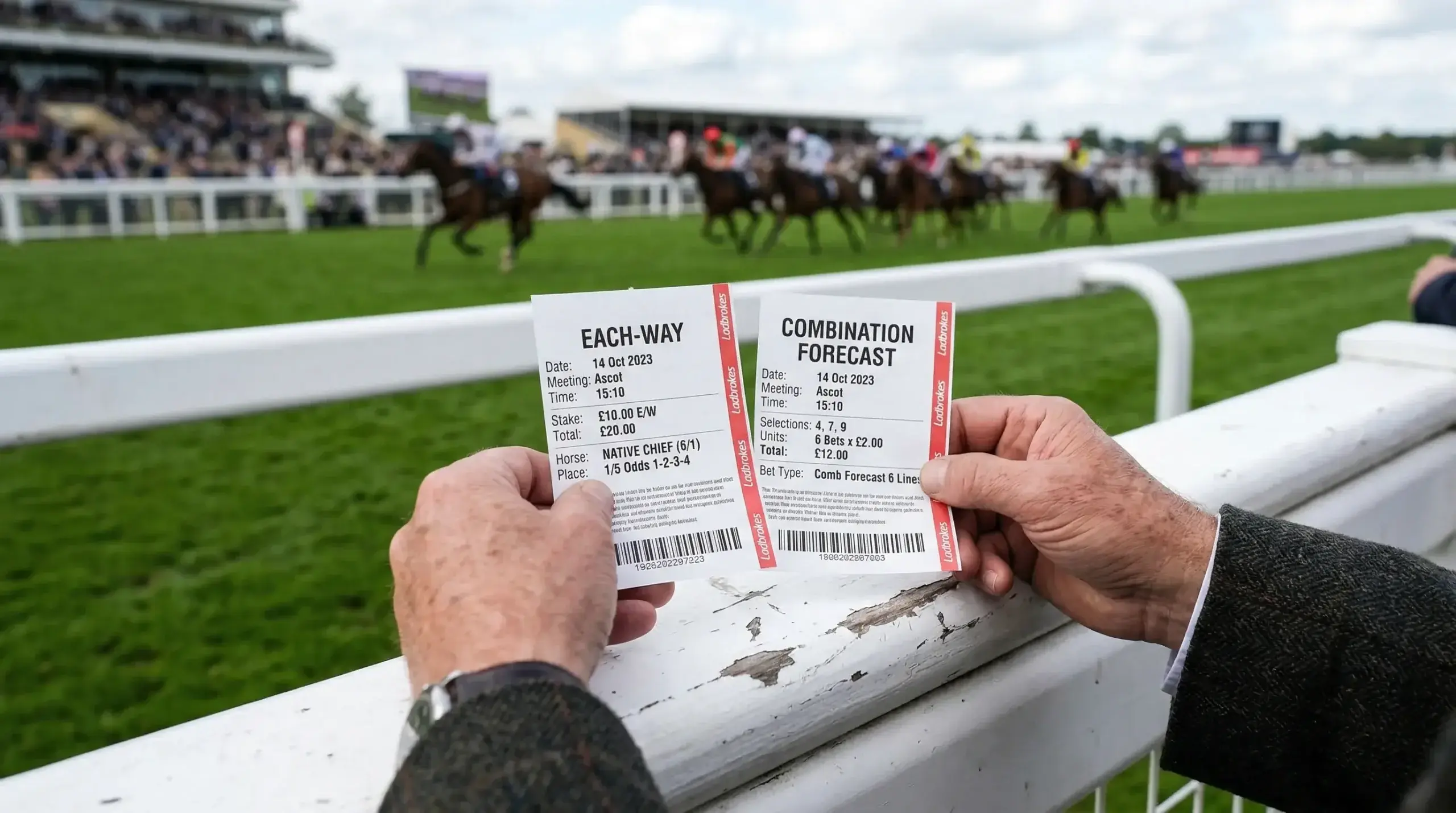
Roughly 70 percent of all horse racing bets placed in the UK are each-way. Exotic bets — forecasts, tricasts, and their combination variants — account for just 8 to 12 percent of total turnover. That disparity tells you something about habit, but it tells you nothing about value. The 70 percent default deserves a second look, because in a significant number of race types, an each way vs box bet comparison lands squarely in favour of the box.
Alex Sherwood, racing journalist and betting analyst at Racing Post, has noted that “the combination forecast and tricast remain underutilised products in British racing. Many punters default to each-way bets without realising that a well-structured box forecast can offer superior value in larger fields.” That observation isn’t speculative — it’s grounded in the payout mechanics of the two bet types, which diverge sharply as field sizes increase.
What follows is not a general comparison. It’s a quantitative, scenario-by-scenario breakdown of what each bet pays in the same race, at the same cost, across three different field sizes. The numbers speak for themselves.
Same Race, Same Horse: What Each-Way Pays vs What a Box Forecast Pays
To make the comparison fair, we need a controlled example. Take a single horse — Horse A, priced at 10/1 — and consider what happens when it finishes in the first two places of a race. We’ll assume standard each-way place terms: one-quarter the odds for a place in a race with 8 or more runners.
Each-Way on Horse A at 10/1, £6 total stake
An each-way bet is two bets: £3 win and £3 place. If Horse A wins, you collect £30 (win at 10/1) plus £7.50 (place at 10/4) for a total return of £37.50 plus your £6 stake — profit of £37.50. If Horse A finishes second or third but doesn’t win, you collect only the place part: £7.50 plus your £3 place stake — profit of £4.50. If Horse A finishes outside the places, you lose £6.
Box Forecast on Horse A plus two others, £6 total stake
A three-horse box forecast at £1 per line costs £6 — the same total outlay. If Horse A finishes in the first two alongside any of your other two selections, you collect the CSF dividend for that combination. In a 14-runner handicap, a typical CSF where one 10/1 shot and another mid-range horse fill the places might be £60 to £100. At £1 per line, your return on the winning line is £60 to £100 — profit of £54 to £94 after deducting the £6 total cost.
The gap is stark. For the same £6 outlay, the each-way bet returns £37.50 profit in the best case (win) and £4.50 in the second-best case (place only). The box forecast returns £54 to £94 when it lands. The each-way bet wins more often — it only needs one horse to place, not two specific horses to fill the top two — but when the box wins, it wins by a much larger margin.
Extend the comparison to a four-horse box forecast at the same £6 budget. At 50p per line, four horses produce 12 permutations costing £6 total. The coverage is broader — any pair from four selections — and the CSF dividend per winning line at 50p stake is half the full dividend, but still substantial. A £90 CSF returns £45 on the winning 50p line, yielding £39 profit. The four-horse box at the same cost as the each-way bet provides broader coverage of the forecast market for a comparable or higher return.
The table below summarises the comparison across different stakes:
| Bet Type | Total Stake | Best-Case Profit | Second-Best Profit | Coverage |
|---|---|---|---|---|
| Each-way (10/1) | £6 | £37.50 (win) | £4.50 (place) | 1 horse, 3 positions |
| 3-horse box forecast (£1/line) | £6 | £54–£94 (CSF) | £0 (miss) | 3 horses, top 2 |
| 4-horse box forecast (50p/line) | £6 | £27–£47 (CSF at 50p) | £0 (miss) | 4 horses, top 2 |
Three Scenarios: Where Each Bet Type Wins
Small Field, 6 to 8 Runners: Each-Way Wins
In a small field, the CSF dividend is compressed because the placed horses are likely to be short-priced. A six-runner race where the 3/1 favourite wins and the 4/1 second favourite runs second might produce a CSF of just £12. A three-horse box forecast at £1 per line costs £6 and returns £12 — a £6 profit. The each-way on the winner at 3/1 costs £6 and returns £15 (win) plus £3.75 (place) — a £12.75 profit. Each-way is the better play in small, predictable fields where the market correctly identifies the principals.
Medium Field, 10 to 14 Runners: Roughly Equal
In a 12-runner handicap, the CSF dividend for a typical result — one mid-market horse winning, another filling second — sits in the £40 to £80 range. A four-horse box forecast at 50p per line costs £6 and returns £20 to £40 on the winning line. The each-way on a 10/1 winner at £6 returns £37.50 if it wins, £4.50 if it places. The two bets are roughly comparable in value, with the box offering a higher ceiling but lower floor. In this zone, your choice depends on how confident you are in a specific horse versus a group.
Large Field, 16+ Runners: Box Forecast Wins
This is where the economics tip decisively. Market favourites win about 33 percent of flat races and 29 percent of National Hunt races. In fields of 16 or more, those percentages drop further, and the frequency of unconsidered results rises. CSF dividends in these races frequently exceed £100, and three-figure CSFs are common in Saturday feature handicaps. A four-horse box forecast at 50p per line costs £6 and returns £50 or more on the winning line. The each-way on a single horse at the same cost offers lower upside and no coverage of the forecast market at all. In large fields, the box is the value play.
The Hybrid Approach: Each-Way for Confidence, Box for Uncertainty
The most practical conclusion isn’t that one bet type is universally better. It’s that each serves a different kind of opinion. When you have a strong view on a single horse — you believe it will win — each-way captures that conviction efficiently. When you can identify a group of contenders but can’t separate them — you believe three or four horses will be involved but don’t know which finishes ahead — the box forecast is the right vehicle.
A hybrid approach uses both. Place an each-way bet on your strongest fancy in the day’s feature race, and place box forecasts on the two or three handicaps where you have a shortlist but no standout. This splits your daily budget between high-probability, lower-return each-way bets and lower-probability, higher-return box forecasts. Over a season, the each-way bets provide a steady trickle of small returns, and the box forecasts provide the occasional jump that shifts your running total from flat to positive.
The 70 percent of UK bets placed each-way aren’t wrong. They’re just incomplete. Adding a box forecast component to your betting mix, targeted at the right races — large-field handicaps where the dividends justify the permutation cost — is how you capture value that most punters walk past every Saturday.