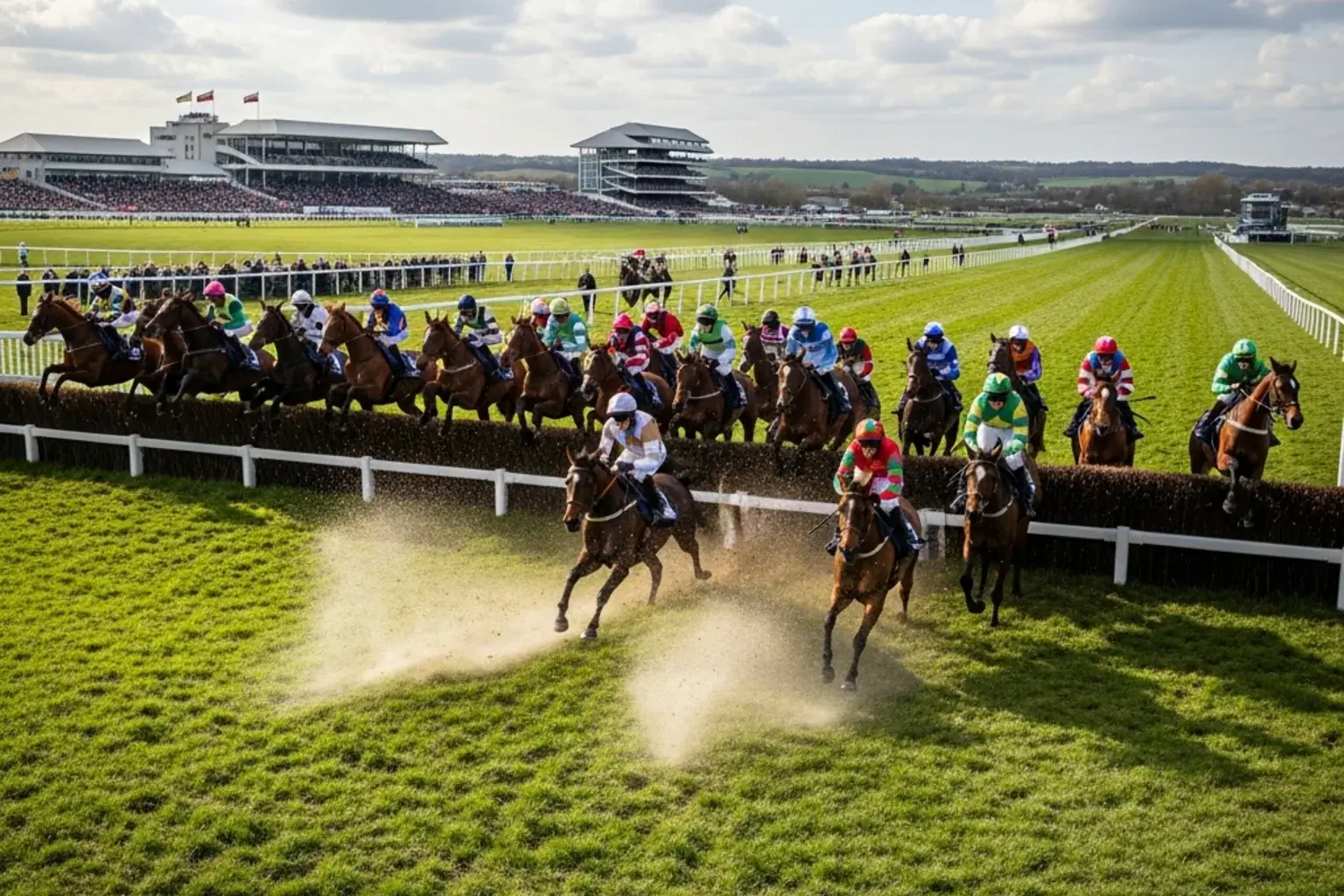
Forty horses, four miles and two-and-a-half furlongs, thirty fences. The Grand National at Aintree is the largest-field race in UK racing, and it poses a question that no other race asks: how do you structure a Grand National box bet when the field is so vast that a straight forecast is functionally a lottery ticket? The answer is not a full box — the numbers forbid it — but a calibrated combination of part-boxes and banker structures that acknowledge the scale without surrendering to it.
The 2024 Grand National produced a CSF that reflected the near-impossibility of predicting the exact first and second from a 40-runner steeplechase. Those dividends are not anomalies at Aintree. They are the structural consequence of a field that generates 1,560 possible first-and-second finishing combinations in a forecast and 59,280 in a tricast. Those numbers aren’t designed to discourage you — they’re designed to show why the bet structure matters more here than in any other race on the calendar.
The Maths of a 40-Runner Field: Why Standard Boxes Break Down
In a typical 14-runner handicap, a four-horse box forecast covers 12 of 182 possible permutations — about 6.6 percent. That’s a meaningful slice. Scale the same approach to the National’s 40-runner field, and the picture changes drastically. A four-horse box forecast in a 40-runner race covers 12 of 1,560 permutations — just 0.77 percent. A four-horse box tricast covers 24 of 59,280 — 0.04 percent. You are, in statistical terms, covering almost nothing.
The BHA schedules roughly 2,300 races per year with fields of 16 or more runners, and the Grand National is the outlier even among those. The standard box bet framework — select three to five horses, cover all permutations — was designed for fields of 10 to 20. At 40 runners, the permutation space explodes beyond what a recreational budget can meaningfully cover with a full box.
Consider the cost trajectory. A five-horse box tricast at £1 per line costs £60 — reasonable in a 14-runner handicap where it covers 1.79 percent of outcomes. In a 40-runner race, those 60 permutations cover 0.10 percent. To reach even 1 percent coverage in the National via a box tricast, you’d need roughly ten horses — producing 720 permutations and a cost of £720 at £1 per line. The cost is real. The coverage is still thin. The full-box approach does not scale to a field this size.
There’s another factor that distinguishes the National from other big-field races: attrition. The 30 fences include some of the most demanding obstacles in jump racing — Becher’s Brook, the Canal Turn, The Chair — and the non-completion rate is significantly higher than in a standard handicap chase. Of 40 starters, typically 15 to 20 finish the race. This effective field shrinkage changes the dynamic mid-race, but it doesn’t change the CSF or CT calculation, which is based on the starting prices of all declared runners. The dividend reflects the 40-runner difficulty; the finish reflects something closer to a 17-runner race. That mismatch is actually part of the National’s appeal for box bettors: the payout assumes maximum difficulty, but the finishing field is considerably smaller.
Part-Box and Banker Structures: Making the National Affordable
The solution is structural, not numerical. Instead of trying to box more horses to compensate for the field size, experienced Aintree bettors use part-box and banker configurations that focus their coverage where their opinions are strongest.
A banker tricast fixes one horse in a specific finishing position — typically first — and boxes the remaining selections for the other positions. If you believe Horse A will win the National but can’t separate Horses B, C, D, and E for the places, a banker tricast with A first and B, C, D, E boxed for second and third produces 12 permutations. At £1 per line, that’s £12 — a fraction of the £60 that a full five-horse box would cost. The trade-off is obvious: if A finishes second instead of first, the bet loses entirely. But in a race where your strongest opinion is about the winner, the banker structure captures that opinion efficiently.
A part-box divides your selections into groups with different roles. You might put two horses in your “top” group — horses you believe will finish first or second — and three in a “wider” group — horses that could finish second or third. This produces fewer permutations than a full box because not every horse is eligible for every position. The exact count depends on the structure, but a well-designed part-box can cut costs by 40 to 60 percent compared to a full box while retaining coverage of the most likely scenarios.
For the Grand National specifically, a practical structure might combine two approaches: a banker forecast with your top pick fixed first and three others boxed for second (producing 3 permutations at £3), plus a four-horse box tricast at minimum stake (24 permutations at 10p, costing £2.40). Total outlay: £5.40. That’s a National bet that respects both your budget and the reality of a 40-runner field. It won’t cover a surprise result involving horses outside your selected group, but no affordable bet structure will. The goal is not to cover everything — it’s to cover the outcomes you believe are most likely at a cost that doesn’t wreck your afternoon.
What the Grand National Has Paid: CSF and CT Dividends
Grand National forecast and tricast dividends sit at the extreme end of the UK range, reflecting the unique field size and the high non-completion rate. In a 40-runner steeplechase, falls, refusals, and pulled-up runners routinely reduce the finishing field to 15 or 20 — but the CSF and CT are calculated on the starting prices of the full field, not the finishers. This means that a 40-runner National where two mid-range outsiders fill the first two places will produce a CSF comparable to what you’d see in a flat handicap with a similar SP profile, but the dividend feels larger because of the perceived difficulty of the race.
CSF dividends at the Grand National have ranged from around £40 — when a well-fancied horse wins with a market rival in second — to several hundred pounds when the places are filled by horses at bigger prices. The CT dividends are correspondingly larger, frequently running into four figures. In years where three outsiders fill the first three places, the Computer Tricast has exceeded £5,000 from a £1 stake.
These payouts need to be weighed against the hit rate. A four-horse box tricast on the National covers just 24 of 59,280 tricast permutations. Even with informed selection, you are facing a low probability of success on any single running of the race. The Grand National is a once-a-year event, and for most box bettors it should be treated as a single, carefully budgeted punt rather than part of a systematic strategy. Keep the stake small, use banker or part-box structures to control cost, and recognise that the National’s appeal for box bettors is the extraordinary dividend potential on the rare occasions it connects — not a reliable source of returns.