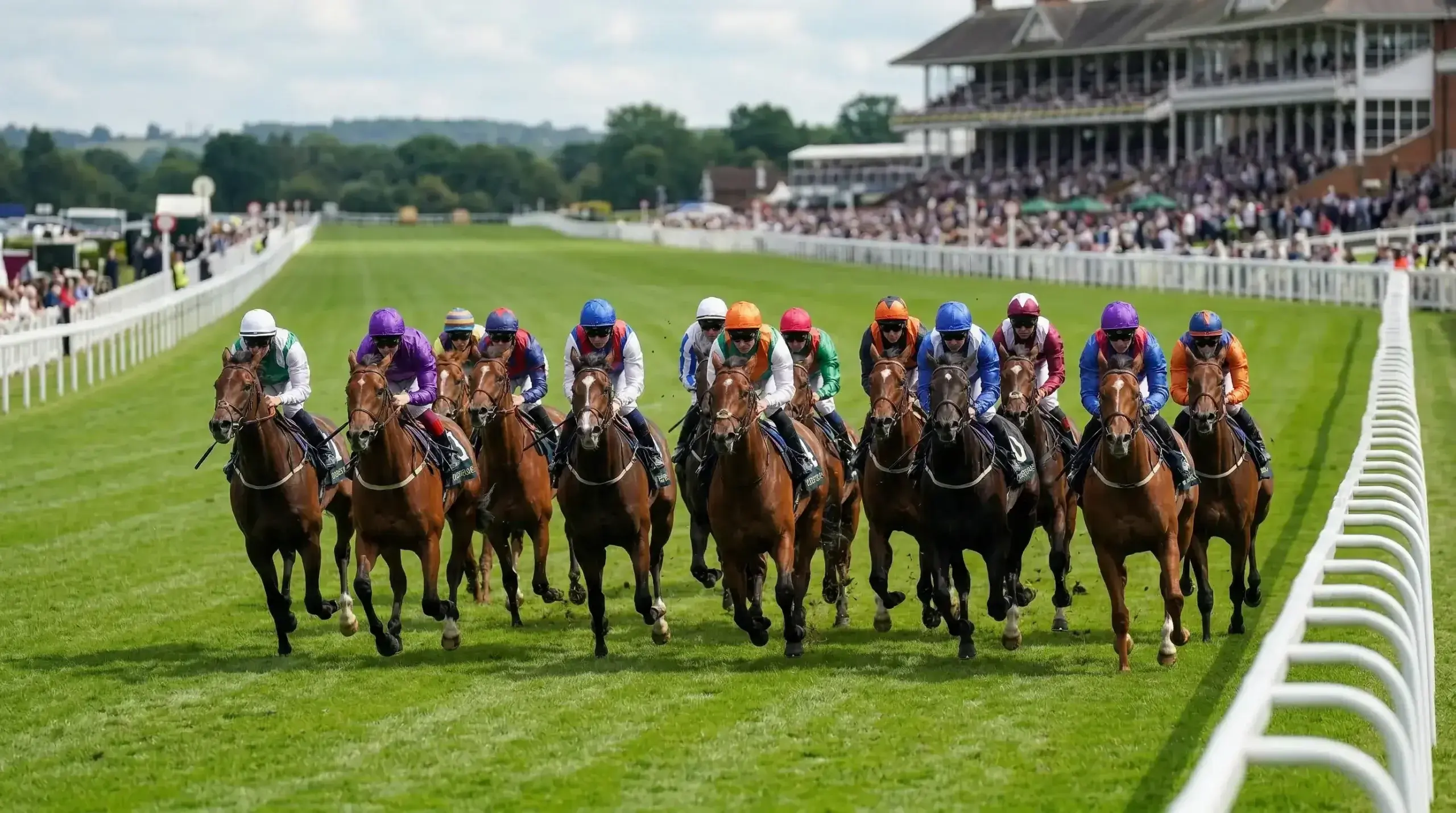
Handicap racing exists to level the field, and a levelled field is exactly what a box bet needs to work. When the BHA handicapper assigns weights so that — in theory — every horse has an equal chance, the finishing order becomes genuinely uncertain, and that uncertainty inflates forecast and tricast dividends. The BHA schedules approximately 2,300 races per year with fields of 16 or more runners, and the vast majority of those are handicaps. Tom Segal, Racing Post’s chief tipster known as Pricewise, puts the target clearly: “In my experience, the most profitable box bets come from handicap hurdles with 12-16 runners where form is reliable but the market struggles to separate the top five or six. That’s where your edge is.”
Handicap racing and box bets are not just compatible — they’re structurally complementary. The handicapper creates competitive fields. The box bet covers the resulting uncertainty. Understanding how handicaps work, and which types of handicap produce the best box bet conditions, is the foundation of informed combination betting. Levelled fields, boxed bets.
How Handicapping Works: Ratings, Weights, and the Levelling Effect
The British Horseracing Authority employs a team of professional handicappers who assign every horse with sufficient form an Official Rating — a numerical expression of the horse’s ability. The scale runs from roughly 0 to 180 in flat racing and from 0 to 175 in jumps, with higher numbers indicating better horses. The handicapper adjusts these ratings after every run based on performance, raising a horse’s OR after a good run and lowering it after a poor one.
In a handicap race, the horse with the highest Official Rating carries the highest weight, and the horse with the lowest carries the lowest. The difference in weight is calculated to neutralise the difference in ability: a horse rated 95 might carry 9 stone 7 pounds, while a horse rated 80 carries 8 stone 6 pounds. In theory, the weight adjustments give every runner an equal chance of winning. In practice, handicappers are very good at their jobs — close finishes and unpredictable results are the norm in well-framed handicaps, not the exception.
This levelling process is what creates the competitive fields that box bettors depend on. In a conditions race, where weights are determined by age and sex rather than ability, the best horse is usually obvious and the result is frequently predictable. In a handicap, the best horse carries the most weight, which compresses the field and distributes winning chances more broadly. That distribution is the engine of box bet value.
The handicapping system also creates “well-handicapped” runners — horses whose current Official Rating understates their true ability. A horse that has improved since its last run, or that was unlucky in its most recent outing, may be running off a rating that is a few pounds too low. These horses offer disproportionate value in handicaps, and they’re the selections that experienced box bettors prioritise. Finding them requires form study, but the handicap framework is what makes them possible: the OR system creates measurable gaps between perceived ability and actual ability, and those gaps are where box bet profits live.
Why Handicap Fields Are More Competitive Than Any Other Race Type
The data bears out the theory. Average field sizes in UK flat handicaps sit at 10.8 runners — the highest of any race type. National Hunt handicaps average 9.2 runners, again the highest within the jumps programme. These averages mask the top end: Saturday feature handicaps regularly attract 16 to 20 runners, and festival handicaps can draw 24 or more.
Field size alone doesn’t guarantee competitiveness, but handicaps deliver on both measures. The spread of finishing margins in handicaps is consistently tighter than in non-handicap races. A Class 3 handicap at Newbury might see the first six finishers separated by three lengths. A Group 3 conditions race at the same meeting might see the winner eight lengths clear of the third. The tight margins in handicaps mean that small differences — a better draw, a more favourable pace, an extra pound of weight — can change the finishing order entirely. For box bettors, this is the environment where coverage pays: when any of your four or five selections could realistically finish in the top three, the probability of your box landing is meaningfully higher than in a race with a dominant favourite.
Favourite strike rates confirm this. In UK handicaps, the market favourite wins approximately 25 to 28 percent of the time — lower than the overall average of 33 percent for flat racing. In the most competitive handicaps — Class 3 and 4 races with 14 or more runners — the favourite’s strike rate drops further, sometimes below 20 percent. That means more than three-quarters of these races are won by horses other than the favourite. The finishing positions are correspondingly distributed, and the forecast and tricast dividends reflect that distribution. A CSF of £60 to £120 is typical; £200 or more is not unusual.
The Ideal Handicap for a Box Bet: Race Profile Checklist
Not every handicap suits a box bet equally well. The ideal profile combines several characteristics that together maximise the dividend potential relative to the box cost.
Field size should be 12 runners or more. Below 12, the CSF dividend compresses because the number of possible finishing combinations is smaller, and the placed horses are more likely to be among the market leaders. At 12 or above, the permutation space is large enough that outsiders can infiltrate the places and push the dividend into the productive range.
The race class should ideally be Class 3 or Class 4. These are the mid-tier handicaps where the runners are competitive but not so well-known that the market prices them accurately. Higher-class handicaps — Class 1 and 2 — attract better-known horses with more form, which gives the market better information and compresses the CSF. Lower-class handicaps — Class 5 and 6 — often attract weaker horses with less reliable form, which increases randomness without necessarily increasing dividends.
The distance sweet spot for box bets is one mile to a mile and a half on the flat, and two miles to two and a half miles over hurdles. These distances attract the largest fields because the horse population is deepest at these trips. Sprints on the flat can also produce excellent box bet conditions — the Wokingham at Royal Ascot being the prime example — but the extreme pace and draw biases add variables that are harder to account for in selection.
Going conditions matter most in jump racing, where soft or heavy ground increases the non-completion rate and adds variance. On the flat, good or good-to-firm ground produces the most reliable form and the most predictable box bet outcomes. This doesn’t mean soft-ground flat handicaps are bad box territory — they’re just higher variance, which can cut both ways.
Apply these criteria as a filter before committing to a box bet on any given race. When a handicap meets all four conditions — 12 or more runners, Class 3 or 4, mile to mile-and-a-half distance, decent ground — you’re looking at a race that is structurally built for combination forecasts and tricasts. The handicapper did the levelling. The field size provides the dividend potential. Your job is to narrow the field to four or five selections. The box does the rest.