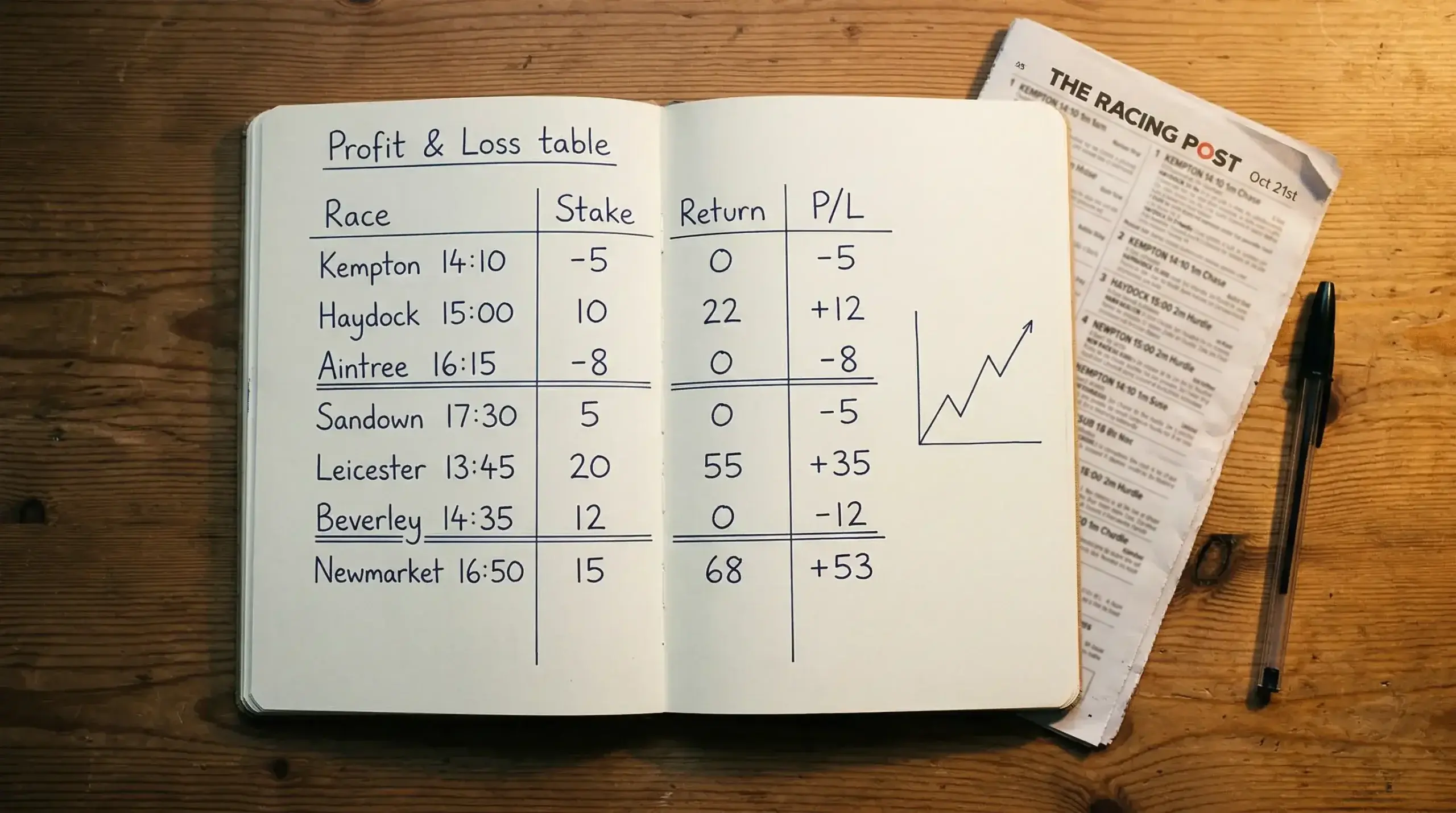
Is box betting profitable in horse racing? The honest answer has two parts. If you select horses randomly and box them in combination forecasts and tricasts, the expected value is negative — you will lose money over time. If you select horses with a systematic advantage over the market — better form analysis, sharper identification of race conditions, disciplined targeting of the right race types — box betting can produce positive returns. The numbers don’t lie, but they don’t doom you either.
An expected value analysis of a five-horse box tricast in a 16-runner handicap illustrates the baseline. The box covers 60 of the 3,360 possible first-three finishing orders — 1.79 percent of outcomes. If the average Computer Tricast dividend for that race type is £2,000, the expected return on a £1 per line box is 0.0179 multiplied by £2,000, which equals £35.70. The box costs £60. At random, you lose £24.30 per bet on average. That’s the starting point — and everything that follows is about whether your selection skill can close that gap.
Expected Value at Three Skill Levels: Random, Competent, and Informed
Random Selection
Pick five horses from a 16-runner handicap with no form analysis, no consideration of race conditions, no filtering. Your probability of including the first three finishers in your five-horse group is approximately 1.79 percent for the tricast (60/3,360). The EV calculation is straightforward: probability of winning multiplied by the average dividend, minus the cost. At a £2,000 average CT dividend and a £60 box cost: (0.0179 times £2,000) minus £60 equals negative £24.30. Over 100 such bets, you’d expect to lose roughly £2,430. Random box betting is a losing proposition, and no staking plan or cost management technique changes that — the edge is negative at the point of selection.
Competent Selection
Now add basic form analysis. You eliminate horses with no recent form, no form at today’s distance, or no form on today’s going. You narrow the 16-runner field to 8 or 9 realistic contenders and select five from that group. Your probability of including the first three finishers in your box roughly doubles — to around 3.5 to 4 percent — because you’ve excluded the most unlikely horses. The EV shifts: (0.035 times £2,000) minus £60 equals £10. You’re now marginally positive per bet. Over 100 bets, the expected profit is roughly £1,000 — thin, but positive. The margin is narrow enough that a bad run of 10 or 15 losing bets can feel like the strategy isn’t working, even if the long-term EV is in your favour.
Informed Selection
Add course form analysis, trainer statistics, going expertise, pace assessment, and systematic comparison of each horse’s Official Rating against its likely finishing position. The best private handicappers and professional analysts operate at hit rates of 5 to 7 percent for four-horse box tricasts in 14-to-16-runner handicaps. At a 6 percent hit rate: (0.06 times £2,000) minus £60 equals £60 profit per bet on average. Over 100 bets, the expected return is £6,000. That’s meaningful — roughly 100 percent return on total outlay — but it requires genuine analytical skill, consistent discipline, and the patience to endure losing runs of 20 or more bets without deviating from the system.
Realistic Hit Rates and What They Mean for Your Bank
A four-horse box forecast in a 12-runner handicap covers 12 of 132 possible first-two permutations — roughly 9 percent at random. With form-based selection, experienced punters report hit rates of 12 to 18 percent for box forecasts on targeted handicaps. That means roughly one winning bet in every six to eight attempts. At a cost of £12 per box (four horses at £1), a run of seven losing bets costs £84. One winning bet at an average CSF of £70 returns £70, which almost covers the losses. You need the winning CSF to be consistently above your box cost times the miss rate to turn a profit — and in well-selected handicaps with 12 or more runners, that’s achievable.
Box tricast hit rates are significantly lower. A four-horse box tricast in a 12-runner handicap covers 24 of 1,320 permutations — about 1.8 percent at random. With informed selection, experienced bettors report hit rates of 3 to 5 percent. That’s one winner in every 20 to 33 bets. At a cost of £24 per box, a run of 25 losing bets costs £600. One winning bet at an average CT of £1,500 returns £1,500 — covering the losses with £900 profit. But if the winning CT is only £800, the profit drops to £200 across the same 25-bet cycle. The tricast rewards patience and punishes underpowered dividends.
Gambling Commission data estimates the average UK horse racing bettor’s annual net loss at £200 to £400. A box tricast strategy that operates at a 4 percent hit rate with average CT dividends of £1,200 — achievable in competitive Class 3 and 4 handicaps — can overcome that baseline. But the variance is high. A box tricast bettor might go 30 or 40 bets without a winner, accumulating losses of £720 to £960, before landing a single bet that recovers the entire deficit in one dividend. That psychological and financial reality requires a bankroll that can absorb extended losing runs, and the discipline not to abandon or alter the strategy mid-streak.
The Verdict: A Tool, Not a System
Box betting is not a system that produces automatic profits. It’s a bet structure — a way of covering finishing-order uncertainty — and its profitability depends entirely on the quality of the inputs. Good selections in the right race types, placed at controlled stakes, can generate positive returns. Poor selections, or good selections in the wrong races, will lose money regardless of the structure.
The maths supports profitability for punters who can consistently identify contenders in competitive handicaps at a rate better than random. The threshold is not impossibly high: you don’t need to be right every time, just often enough that the winning dividends outweigh the cumulative cost of the losing boxes. For box forecasts, that threshold is roughly one winner in seven attempts at an average CSF of £70 or higher. For box tricasts, it’s roughly one winner in 25 attempts at an average CT of £1,200 or higher.
Can you hit those numbers? That depends on how seriously you study the form, how disciplined you are about race selection, and how rigorously you manage your staking. The average annual bettor loss of £200 to £400 reflects a population that mostly bets without structured analysis. A punter who applies form study, field-size filters, and cost discipline to their box betting is operating in different territory — and the numbers, while demanding, are not hostile to that approach.
Box betting is profitable for some people. The question is whether you’re willing to do the work that puts you in that group. The form study, the race-type filtering, the staking discipline, the patience through losing streaks — these are the inputs that determine whether the maths works in your favour or against it. The numbers don’t promise profits. They promise that profits are possible for those who earn them.