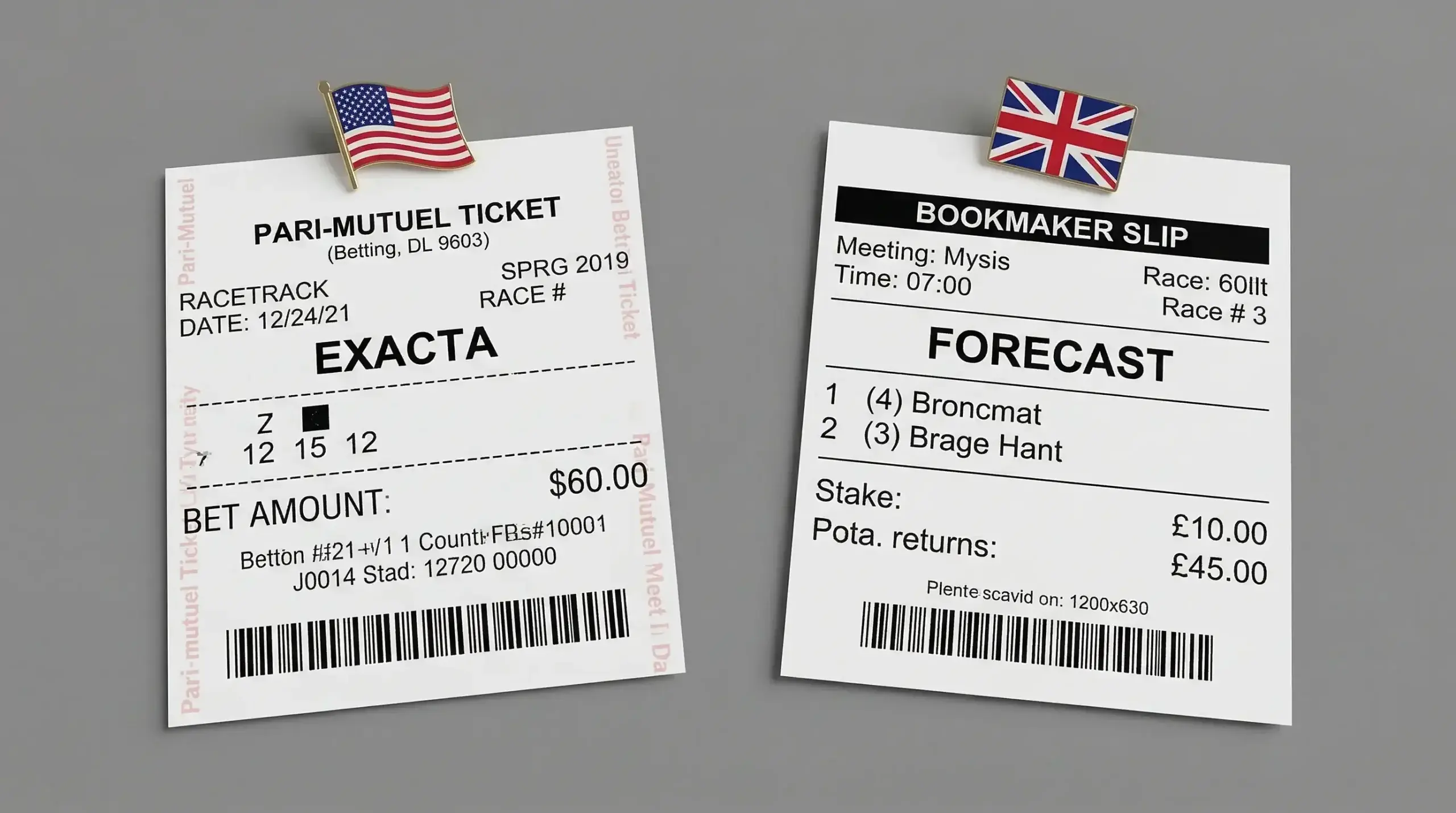
An exacta vs forecast horse racing comparison starts as a translation exercise and ends as a lesson in payout mechanics. The bets look identical: pick the first two finishers. But James Willoughby, racing analyst at Timeform and Racing Post, has identified the fundamental divergence: “British racing’s forecast and tricast markets are fundamentally different from American exotic pools. CSF is calculated by an algorithm, not by pool size, which means the payouts reflect true probability rather than crowd sentiment.”
That distinction isn’t semantic. It means the same finishing result — same horses, same positions — can pay different amounts in the US and UK, because the dividend in each country is generated by a different system. If you’re a UK punter reading American betting content, or an American punter trying to apply US strategies on British races, the terminology gap will mislead you unless you understand what’s behind the names. Same bet, different rules — and the rules affect your wallet.
The Complete Term Map: Every US Exotic and Its UK Equivalent
| US Term | UK Equivalent | What It Requires | Key Difference |
|---|---|---|---|
| Exacta (straight) | Straight Forecast | 1st and 2nd in exact order | US: pool payout. UK: CSF algorithm or Tote Exacta pool |
| Exacta (box) | Combination Forecast | 1st and 2nd in any order | Same structure; different settlement |
| Quinella | Reverse Forecast | 1st and 2nd in either order (2 horses only) | US: separate fixed pool. UK: two straight forecasts bundled |
| Trifecta (straight) | Straight Tricast | 1st, 2nd, and 3rd in exact order | US: pool payout. UK: CT algorithm or Tote Trifecta pool |
| Trifecta (box) | Combination Tricast | 1st, 2nd, 3rd in any order | Same structure; different settlement |
| Superfecta (straight) | First Four (straight) | 1st through 4th in exact order | Limited availability in UK |
| Superfecta (box) | First Four (combination) | 1st through 4th in any order | Available on selected UK races via Tote |
| Daily Double | No direct equivalent | Winners of two specified races | UK uses accumulators instead |
| Pick 3 / Pick 4 / Pick 6 | Placepot / Jackpot / Scoop6 | Multiple race selections | Structure varies significantly |
The table reveals a largely one-to-one mapping for the core exotic bets. Exacta equals forecast. Trifecta equals tricast. Superfecta equals first four. The structures are the same: pick horses for specific finishing positions, with the option to box. Where the mapping breaks is in the settlement and in the multi-race products, where the UK’s Tote ecosystem operates quite differently from American pari-mutuel wagering.
One term that causes persistent confusion is quinella. In the US, the quinella is a distinct pool product — it has its own pool, separate from the exacta pool, and the dividend is independently calculated. In the UK, there is no separate quinella pool or product. The equivalent — a reverse forecast — is simply two straight forecast bets packaged together. The payout on a reverse forecast is the CSF for whichever order actually occurs. There’s no “quinella dividend” in British racing. Computer Straight Forecast dividends on UK races range from roughly £15 to over £250, and the same CSF applies whether you placed a straight forecast or one line of a reverse forecast.
Why the Same Result Pays Differently: Pari-Mutuel vs CSF vs Tote
In the United States, virtually all exotic bets are settled through pari-mutuel pools. All stakes go into a pool, the track takes a percentage — typically 18 to 25 percent — and the remainder is divided among winning ticket holders. The dividend depends on two things: the total pool size and the number of winning tickets. Popular results pay less. Unpopular results pay more. The system is simple and transparent, but it means your payout is directly affected by what other people bet.
In the UK, the landscape is more complex because two settlement systems coexist. Traditional bookmakers settle forecasts and tricasts using the CSF and CT algorithms — mathematical formulas that derive a dividend from the starting prices of the finishing horses. No pool is involved. The dividend is calculated post-race by an algorithm, and it’s the same for every winning bettor regardless of how many people backed the combination. The CSF is immune to crowd behaviour, which is both its strength and its limitation: it can’t overpay on an unpopular result the way a pool can, but it also can’t underpay on a popular one.
Alongside the bookmakers, the UK Tote operates pool-based products — Exacta and Trifecta — that function on pari-mutuel principles similar to the American system. The Tote’s Exacta pools on major UK races regularly reach £20,000 to £80,000, providing meaningful liquidity. When a surprise result occurs, the Tote Exacta can pay substantially more than the CSF, because the pool is concentrated among few winning tickets. When a popular result occurs, the Tote typically pays less.
The practical consequence for a UK punter reading US-focused guides is this: strategies optimised for pari-mutuel pools — like targeting underlaid combinations or avoiding popular bets — apply to Tote pool bets but not to CSF-settled bookmaker bets. If you’re following a US handicapper’s advice about exotic betting value, you need to ask whether the value argument depends on pool dynamics. If it does, the advice is only relevant for your Tote bets, not for your combination forecasts with a traditional bookmaker.
What This Means If You Read US Content and Bet in the UK
Three adjustments are needed. First, translate the terminology — every time you see “exacta,” read “forecast”; every time you see “trifecta,” read “tricast.” The bet structures are functionally identical, and any selection methodology that works for one works for the other.
Second, discard any advice about pool manipulation, overlay hunting within pools, or timing your bets to influence pool dividends. These concepts are relevant to US pari-mutuel betting and to UK Tote bets, but they are irrelevant to CSF-settled bets with UK bookmakers. The CSF pays what the algorithm dictates, regardless of pool dynamics.
Third, recognise that you have a choice the American bettor does not. In the US, the pari-mutuel pool is the only settlement option for exotic bets. In the UK, you can choose between the CSF via a traditional bookmaker and the Tote’s pool. That dual system gives you an edge: for any given race, you can compare the likely CSF with the likely Tote dividend and route your box bet to whichever platform offers the better return. American bettors have one number. You have two — and the one you choose can make a material difference to your profit over a season.
There’s a fourth point, less obvious but equally important. US content often discusses “keying” a horse in an exotic — fixing one horse in first and boxing others below. In UK terminology, this is a banker forecast or banker tricast. The concept translates directly, and it’s one of the most useful ideas to import from US handicapping literature. The execution is identical; only the name changes. If you find a US source discussing exacta and trifecta strategy, check whether their advice involves selection logic — which horses to include, how many to use, when to banker — or pool mechanics. The selection logic is universally applicable. The pool mechanics need adapting for the UK’s dual-settlement system. Separate the two, and you can read any US exotic betting guide without being led astray.