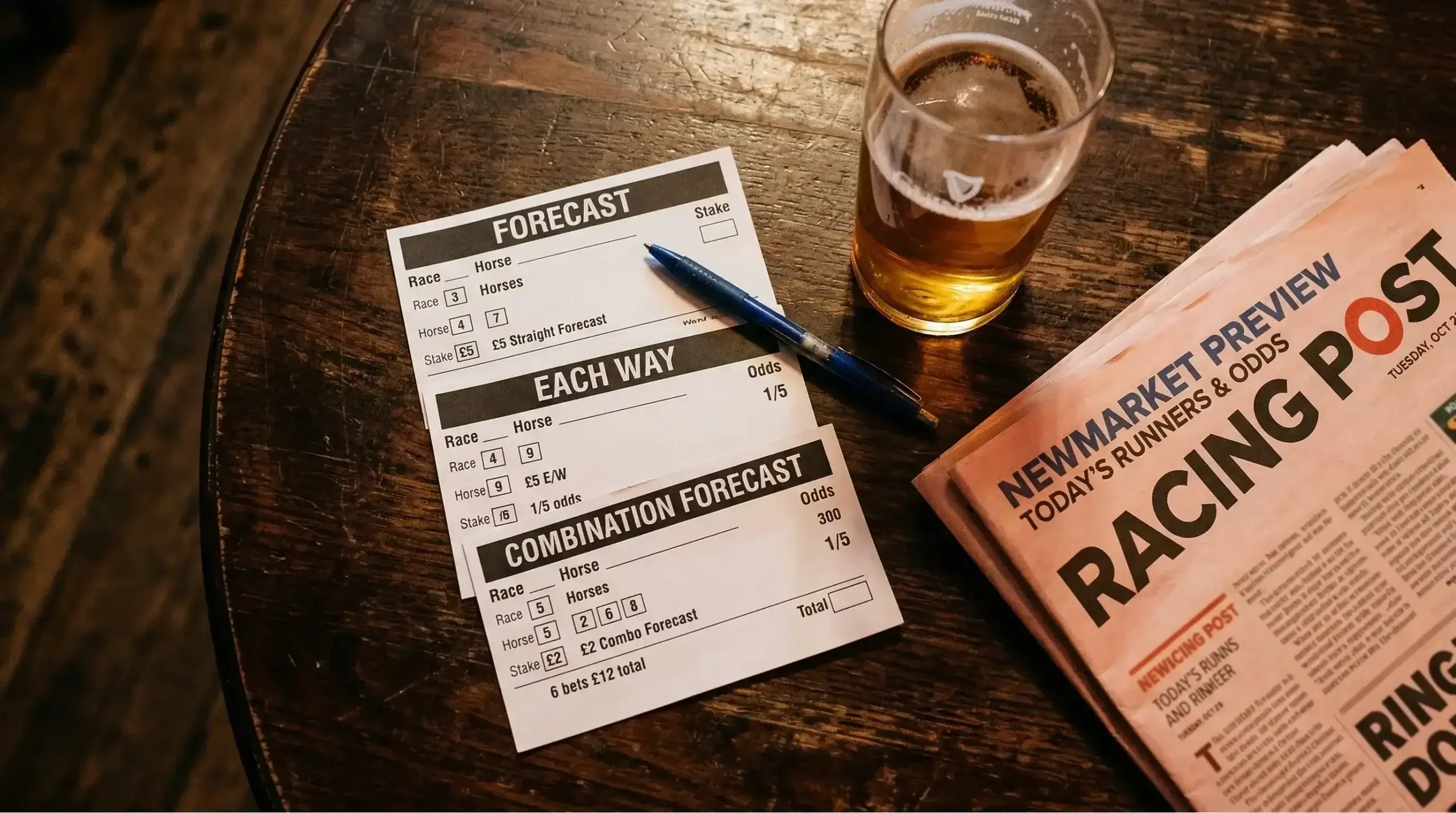
No Single Bet Type Wins Every Race: How to Match Wager to Situation
The UK betting market offers horse racing punters a menu of wager types that ranges from the elementary — a win single at fixed odds — to the structurally complex, like a box tricast covering dozens of permutations. Each has a purpose. None is universally superior. The box bet vs straight bet question, and the broader box bet vs each-way debate, don’t have a blanket answer. They have situational answers, and the right bet for a 16-runner handicap at Newbury bears almost no resemblance to the right bet for a five-runner conditions stakes at Sandown.
What makes the UK market distinctive is the dominance of each-way betting. Estimates from the British Horseracing Authority’s economic research suggest that exotic and forecast bets account for only 8 to 12 per cent of total horse racing turnover, with standard win and each-way wagers taking the lion’s share. That imbalance isn’t because each-way is always the best value. It’s because each-way is familiar, simple, and embedded in the UK punting culture. The combination forecast and tricast sit in the exotic margin — underused, often misunderstood, and available at every major bookmaker for anyone willing to look past the default.
This article compares the main wager types head to head. Not in theory, but with cost data, probability structures, and payout ranges attached. You’ll see box bets measured against straight forecasts, each-way wagers, quinellas, reverse forecasts, and accumulators — each assessed on the conditions where it performs best and the conditions where it wastes money. The goal is a practical framework: the right bet, the right race, every time you open a racecard. Not loyalty to a bet type, but clarity about which tool fits which job.
Box vs Straight Forecast: A Full Cost-Probability-Payout Breakdown
A straight forecast requires you to name the first and second finishers in the correct order. A box forecast (combination forecast) requires you to name them but lets them finish in either order. The structural difference is permutations: a straight forecast is one bet; a two-horse box is two bets; a four-horse box is twelve. The cost multiplies, but so does the coverage.
The formula for a box exacta is n x (n – 1) x stake, where n is the number of horses selected. For a straight forecast, the formula is simply 1 x stake. The comparison becomes concrete when you attach field sizes and average dividends.
| Field size | Total permutations | Straight forecast: cost (£1) | Straight forecast: probability | 4-horse box: cost (£1/line) | 4-horse box: probability | Typical CSF range |
|---|---|---|---|---|---|---|
| 6 | 30 | £1 | 3.33% | £12 | 40.0% | £8-£30 |
| 8 | 56 | £1 | 1.79% | £12 | 21.4% | £15-£50 |
| 10 | 90 | £1 | 1.11% | £12 | 13.3% | £20-£80 |
| 12 | 132 | £1 | 0.76% | £12 | 9.1% | £30-£120 |
| 16 | 240 | £1 | 0.42% | £12 | 5.0% | £50-£250 |
| 20 | 380 | £1 | 0.26% | £12 | 3.2% | £80-£400+ |
The probability column assumes random selection — equally likely outcomes — which no informed bettor actually faces. But it illustrates the structural argument. In a 16-runner field, a straight forecast gives you a 0.42 per cent base probability per attempt. A four-horse box lifts that to 5 per cent. The cost of that upgrade is £12 versus £1. The typical CSF range in a 16-runner handicap — £50 to £250 — means the box pays for itself whenever the winning combination falls within your four selections, and the straight forecast needs to hit the exact ordering to return anything at all.
The trade-off sharpens in small fields. In a six-runner race, the straight forecast already has a 3.33 per cent base probability. A four-horse box raises that to 40 per cent but costs twelve times more. The CSF dividend in a six-runner race — often under £30 — may not clear the £12 outlay frequently enough to justify the approach. The box bet’s advantage over the straight forecast scales with field size. In small fields, the straight bet is cleaner. In large fields, the box is structurally superior for anyone who can identify contenders without being certain of their exact finishing order.
One nuance. A box forecast doesn’t halve the CSF dividend — you receive the full Computer Straight Forecast for whichever permutation wins. If you box horses A, B, C, and D, and horses C and A finish first and second, you collect the CSF for C-A at your unit stake. The other eleven combinations lose. Your net result is the CSF minus the total box cost. This means the box bettor’s breakeven point is the CSF value that equals the total outlay. For a £12 four-horse box, any CSF above £12 produces a net profit. In handicaps with 12 or more runners, the median CSF comfortably exceeds that threshold.
Box Forecast vs Each-Way: The UK’s Most Important Betting Choice
Each-way is the default wager for most UK punters. It splits your stake into two parts: half on the horse to win, half on it to place (finish in the first two, three, or four, depending on the number of runners and the race type). The place part pays at a fraction of the win odds — typically one-quarter or one-fifth. It’s simple, it’s familiar, and it provides a return even when your horse doesn’t win. For a single-selection bettor, each-way is hard to argue against.
But the comparison with a box forecast isn’t about a single selection. It’s about the difference between two betting philosophies. An each-way bet says: “I think this one horse will finish near the front.” A box forecast says: “I think two or more of these horses will finish in the first two, but I can’t separate their order.” These are different opinions expressed through different structures, and each is optimal in different conditions.
Consider a 14-runner handicap where you fancy three horses. An each-way bet on all three at £5 each way (£10 per horse, £30 total) gives you a win return if any of them wins and a place return if any of them finishes in the first three. The place return at 1/4 odds for a horse at 10/1 is £17.50 (including your £5 stake back). Not bad, but not transformative.
A box exacta on the same three horses at £1 per line costs £6. If two of them finish first and second, you collect the full CSF — which in a 14-runner handicap is likely to be between £40 and £150. At 50p per line, the same box costs £3. The payout ceiling for the box is multiples higher than the each-way place return, while the cost is a fraction of the each-way outlay.
The catch is the strike rate. Each-way bets win (or place) more often than box forecasts connect. A horse with a 20 per cent chance of placing provides a frequent, small return. A box forecast that needs two of your three horses in the first two is a lower-probability event. The each-way bettor collects modest returns regularly. The box bettor collects larger returns less often. Over a season, the question is which approach produces the better net return — and the answer depends on the dividend range of the races you target.
“The combination forecast and tricast remain underutilised products in British racing,” observes Alex Sherwood, betting analyst at the Racing Post. “Many punters default to each-way bets without realising that a well-structured box forecast can offer superior value in larger fields.”
Sherwood’s point lands hardest in big-field handicaps. When market favourites win only about 33 per cent of flat races and 29 per cent of jumps races, the each-way bettor who backs a single horse at each-way odds is fighting a headwind: the favourite loses two-thirds of the time, and other selections fare no better on average. A box forecast on three or four contenders in the same race captures a wider outcome set at a lower total cost. In a 16-runner handicap, £6 on a three-horse box versus £30 on three each-way bets: the box wins on cost efficiency unless the each-way bettor is selecting winners at a rate well above the market average.
The practical guidance: use each-way for races where you have a single strong selection in a field of 10 or fewer runners. Use box forecasts for handicaps with 12 or more runners where your form analysis identifies multiple contenders but no clear standout. In the middle ground — 10 to 12 runners, two fancied horses — either approach works, and the choice comes down to whether you’d rather have a higher probability of a modest return (each-way) or a lower probability of a substantially larger one (box). There is no universal winner. There is only the right bet for the right race.
Box Exacta vs Quinella vs Reverse Forecast: Clearing the Confusion
Three terms, three different bet structures, and a web of confusion that catches punters moving between US and UK betting terminology. The box exacta, the quinella, and the reverse forecast all involve picking two horses to finish in the first two places. The differences lie in how many bets each structure contains, how the payout is calculated, and which UK bookmakers offer each option.
A reverse forecast is the simplest variant. You select two horses and place two straight forecasts: Horse A first and Horse B second, plus Horse B first and Horse A second. Total cost: two units. If either ordering comes in, you collect the Computer Straight Forecast for that specific result. A reverse forecast on two horses is functionally identical to a two-horse box exacta — same coverage, same cost, same payout. The terminology differs because “reverse forecast” is the traditional UK term, while “box exacta” originates from US racing. In practice, ticking “reverse forecast” on a UK bet slip and ticking “combination forecast” with two selections produce the same bet.
The difference emerges when you add a third horse. A reverse forecast is defined as two bets — it only covers two horses in both orderings. A box exacta (combination forecast) extends the concept to three or more selections, covering all pairwise permutations. Three horses in a box produce six bets. Four produce twelve. The reverse forecast doesn’t scale beyond two selections by definition. If you want to cover three or more horses, you need a combination forecast, not a series of reverse forecasts — though a punter could, in theory, place three separate reverse forecasts on three pairs (A-B, A-C, B-C), producing the same six bets at the same cost. The combination forecast just packages them automatically.
The quinella occupies different ground entirely. In its original form — common in Australian and some US racing — a quinella is a single pool bet where you pick two horses to finish first and second in either order. Unlike a forecast (which pays the CSF), a quinella pays a pool dividend: the total quinella pool minus operator commission, divided among winning tickets. UK racing does not operate a dedicated quinella pool. The Tote offers an Exacta pool, which pays for a correct first-second prediction in the exact order. To cover both orderings through the Tote, you place two Exacta bets — effectively a reverse Tote Exacta. There is no single-bet “any order” Tote product equivalent to the Australian quinella.
This matters for two reasons. First, the payout mechanism is different. A CSF reverse forecast pays based on an algorithm reflecting the starting prices. A Tote Exacta pays based on pool distribution. The same result can produce different dividends from the two systems, and there’s no way to know in advance which will pay more. Second, the minimum stake structure differs. Most fixed-odds bookmakers allow 10p per line on forecasts, meaning a reverse forecast costs 20p. Tote Exacta minimum stakes are typically £1 per unit on-course and lower online, but the per-unit minimum can vary by platform.
The practical summary: if you’re selecting two horses, a reverse forecast and a two-horse box exacta are the same bet under different names. If you’re selecting three or more, use the combination forecast. And if someone mentions a quinella in the context of UK racing, clarify whether they mean a reverse forecast (CSF-based) or a Tote Exacta in both directions (pool-based), because the term itself doesn’t have a fixed UK meaning.
When an Accumulator Beats a Box Bet (and Vice Versa)
Accumulators and box bets both appeal to punters seeking outsized returns from small stakes, but the mechanics are entirely different. An accumulator chains win bets across multiple races: Horse A to win Race 1, Horse B to win Race 2, Horse C to win Race 3, and so on. The odds multiply. A four-horse accumulator at 5/1, 4/1, 6/1, and 3/1 returns £840 from a £1 stake if all four win. The payout is enormous because the probability is tiny — all four selections must win their respective races.
A box bet operates within a single race. It covers multiple finishing orders of selected horses in one event. The payout is determined by the CSF or CT dividend, which reflects the difficulty of the specific result within that race. The box bettor doesn’t need every selection to win — just two (for a forecast) or three (for a tricast) to finish in the right positions in any order.
The risk profiles are fundamentally different. An accumulator is an all-or-nothing bet. One losing leg and the entire stake is gone. A four-horse box tricast can tolerate one of the four selections finishing out of the places — the remaining three still provide the winning combination. The accumulator has higher upside but lower resilience. The box bet has lower peak upside but higher structural probability of returning something.
When does an accumulator make more sense? In small-field races where you have a strong win opinion. If you’ve identified three horses across three different races that each has a genuine 40 per cent chance of winning, a three-fold accumulator at combined odds of 15/1 to 25/1 is a reasonable bet. Boxing each of those three races individually would cost more in total and the individual race dividends might not match the accumulator payout.
When does a box bet win? When your edge is within a single race rather than across multiple races. If a 16-runner handicap presents three or four contenders that you can identify through form analysis, a box forecast or tricast on that one race converts your knowledge into a bet with structural coverage. An accumulator doesn’t help here — it requires winners across races, not contenders within one.
There’s also a hybrid approach that experienced bettors use: placing box bets in the strongest handicap on a card and an accumulator across the less competitive races where win opinions are clearer. This splits the bankroll between a high-probability, single-race bet (the box) and a low-probability, multi-race bet (the accumulator). The two structures complement each other because they target different types of edge — intra-race coverage versus inter-race conviction.
One point of caution. Accumulators carry significantly worse expected value than single bets because the bookmaker’s margin compounds across each leg. A box bet’s margin is taken once (through the CSF algorithm or Tote pool commission). An accumulator’s margin is taken four, five, or six times. Over a season of consistent betting, the compounding margin advantage of box bets — margin applied once per bet rather than once per leg — is a genuine structural edge that accumulator bettors don’t enjoy.
The Decision Matrix: Which Bet for Which Race
The preceding sections compare bet types in pairs. In practice, the decision happens all at once: you open a racecard, assess the conditions, and choose a wager type. The matrix below synthesises the comparisons into a single reference that maps race conditions to recommended bet types.
| Race type | Field size | Your confidence | Recommended wager |
|---|---|---|---|
| Handicap | 16+ | Multiple contenders, no standout | Box forecast or box tricast (part-box if 20+) |
| Handicap | 12-15 | 3-4 fancied horses | Box forecast (4 selections) or box tricast (3-4) |
| Handicap | 8-11 | Strong view on 2-3 horses | Reverse forecast or small box exacta (3 selections) |
| Handicap | Under 8 | Clear favourite | Straight forecast or win single |
| Conditions/Listed/Group | Any (usually 5-10) | Confident in winner | Win single or straight forecast |
| Conditions/Listed/Group | Any | Two-horse race | Reverse forecast |
| Maiden (flat) | 12+ | Form available on most runners | Box forecast (3-4 selections) |
| Maiden (flat) | Any | Heavy debutant presence | Win single on best-formed horse, or pass |
| Novice hurdle/chase | 10+ | Mixed form profiles | Box forecast (3 selections) |
| Any | Any | Strong win views across card | Accumulator (2-4 legs) |
| Any | Under 8 | One horse fancied, long odds | Each-way single |
The matrix is a starting point, not a rigid prescription. Racing produces conditions that don’t fit neatly into any grid: the 9-runner handicap where three horses are inseparable, the 18-runner novice hurdle at the Cheltenham Festival, the conditions race that attracts an unexpectedly large field. In these cases, the underlying principles still apply. Larger fields favour boxes. Smaller fields favour straight bets. Competitive markets favour coverage. Dominant favourites favour conviction.
Two habits make the matrix useful in practice. First, check the field size and race type before forming any opinion about which horse to back. The race conditions should tell you the bet type; the form analysis then tells you the selections. Working in this order — structure first, selections second — prevents the common trap of picking a horse and then searching for a bet type to fit the pick. Second, revisit the matrix after the final declarations, not after the overnight market forms. Non-runners can change a 14-runner handicap into a 10-runner race, shifting it from optimal box territory into selective-box or straight-bet territory.
A worked example ties the matrix together. Saturday card at York, six races. Race 1: a 7-runner Listed stakes — your view is a straight forecast between two quality fillies. Race 3: a 14-runner Class 3 handicap — four contenders identified, no clear pick between them — box exacta on four at 20p per line, £2.40 total. Race 5: a 22-runner Heritage Handicap — five fancied horses but the field is too large for a full box tricast (60 combinations) — anchor your strongest opinion in first, box four others for second and third via a part-box tricast. Total outlay across the card: under £15. Each bet type matched to its race. That’s the matrix in practice, and it’s the habit that produces consistent returns rather than occasional lucky hits. The right bet for the right race — recalibrated every time the conditions change.