
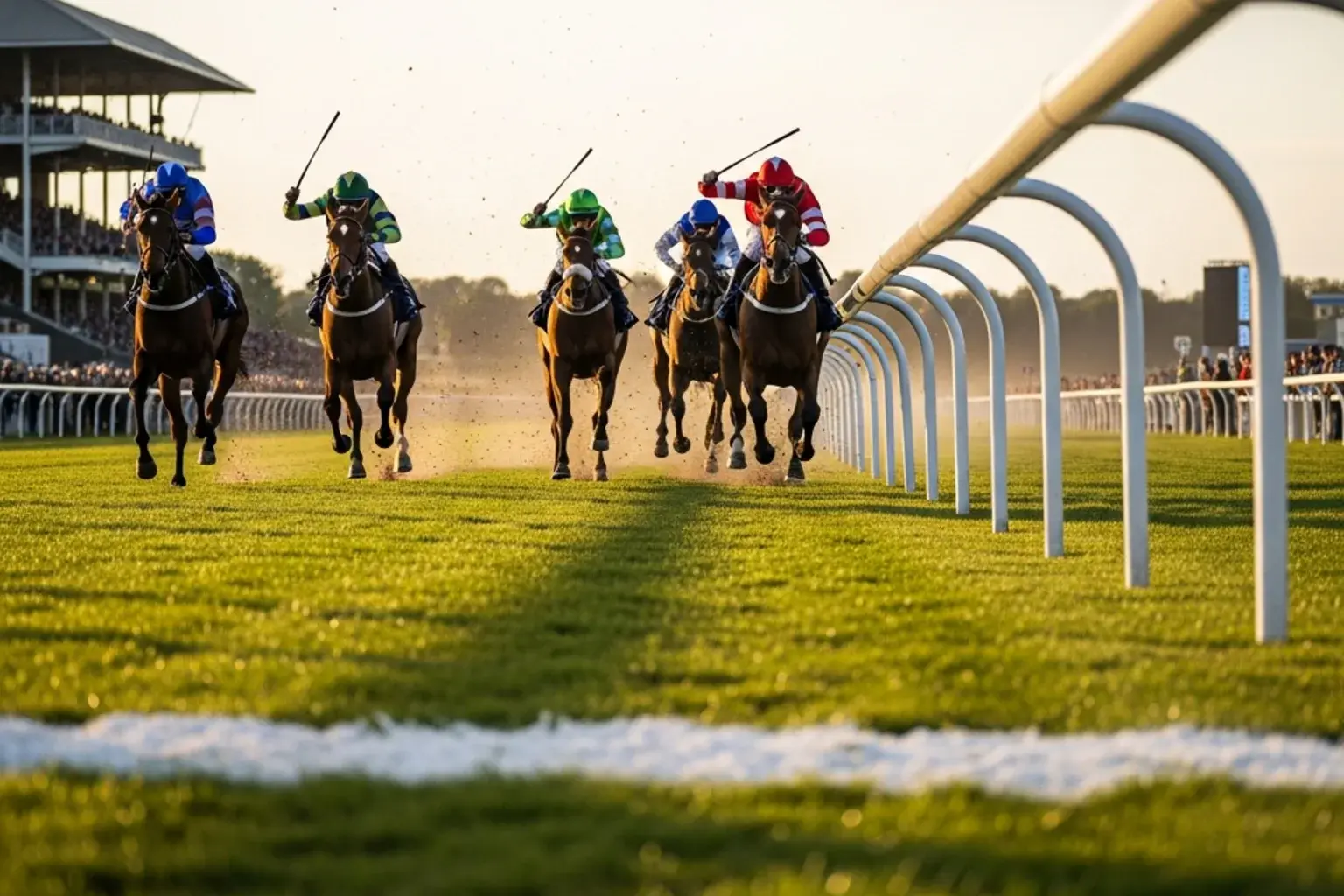
A box superfecta asks you to name four horses that will fill the first four finishing positions — in any order. It sounds like a modest extension of the tricast. It is not. The maths punishes you for that fourth position with a ferocity that catches even experienced bettors off guard. Six horses in a box superfecta produce 360 combinations. At a £1 unit stake, that’s £360 on a single race. Nick Mordin, the veteran betting author, once noted that boxing a tricast in a big handicap is an honest admission that you can’t separate your contenders. A box superfecta in horse racing takes that honesty and charges you roughly fifteen times the price.
The superfecta — sometimes called a “first four” bet — occupies a peculiar position in UK racing. It’s the highest-variance standard exotic bet available, it’s offered by fewer operators than forecasts or tricasts, and the potential dividends are correspondingly enormous. But the cost-to-coverage ratio is brutal, and this guide exists to lay out the numbers before you decide whether the bet deserves a place in your repertoire.
Think of it as four deep, think twice. The arithmetic is about to explain why.
The Permutation Explosion: What a Box Superfecta Actually Costs
The formula for a box superfecta is n times (n minus 1) times (n minus 2) times (n minus 3), where n is the number of horses you select. That fourth multiplicative factor is what separates the superfecta from the tricast in cost terms. A box tricast on five horses produces 60 combinations. A box superfecta on the same five horses produces 120 — double. And the gap only widens from there.
| Horses Selected | Combinations | Cost at £0.10 | Cost at £0.50 | Cost at £1 |
|---|---|---|---|---|
| 4 | 24 | £2.40 | £12.00 | £24 |
| 5 | 120 | £12.00 | £60.00 | £120 |
| 6 | 360 | £36.00 | £180.00 | £360 |
| 7 | 840 | £84.00 | £420.00 | £840 |
| 8 | 1,680 | £168.00 | £840.00 | £1,680 |
Look at the jump from six to seven horses: 360 to 840 combinations. That’s an additional 480 permutations from a single extra selection. At even the minimum 10p per line, adding a seventh horse increases your outlay by £48. The curve is not steep — it is vertical compared to forecast and tricast growth.
Context makes these numbers real. The BHA oversees approximately 2,300 races per year with fields of 16 or more runners — the large-field handicaps where exotic bets offer the most interesting dividend potential. In a 16-runner race, the total number of possible first-four finishing orders is 16 times 15 times 14 times 13, which equals 43,680. A five-horse box superfecta covers 120 of those — about 0.27 percent of all possible outcomes. You are, in essence, casting a net that covers barely a quarter of one percent of the water.
Compare that with a five-horse box tricast in the same race: 60 combinations out of 3,360 possible top-three orders, which is 1.79 percent coverage. The tricast gives you roughly seven times the proportional coverage of the superfecta for half the cost. That comparison alone explains why most serious exotic bettors in UK racing stop at the tricast and treat the superfecta as a special-occasion wager at best.
The dividend potential, naturally, is what keeps the superfecta alive as a bet type. If the first four finishers include two or three outsiders, the payout can be staggering — five-figure dividends from a £1 stake are not unheard of on the rare occasions a superfecta lands in a large-field handicap. The question is whether those payouts compensate for the frequency of losing, and the honest answer for most punters is: rarely.
Where You Can Place a Box Superfecta in UK Racing
Availability is the first practical hurdle. Unlike combination forecasts and tricasts, which are offered by virtually every major UK bookmaker and through the Tote, the superfecta occupies a narrower corner of the market. The Tote offers a first-four product on selected races, typically at major festivals and on feature-race days where liquidity justifies the pool. Outside those windows, the product may not be available.
Among fixed-odds bookmakers, the picture is inconsistent. Some operators offer a Computer First Four product settled algorithmically, similar to the CSF and CT, but this is less standardised across the industry than forecast and tricast settlement. Before planning a superfecta strategy around a particular meeting, check whether your chosen bookmaker or Tote platform actually lists the bet type for that race. There is nothing more frustrating than doing the form analysis, deciding on your five-horse box, and discovering the option isn’t on the bet slip.
On-course, the Tote’s self-service terminals offer the most reliable access to superfecta pools on the days they’re available. The minimum stake at Tote terminals is typically £1 per line, which means even a four-horse box superfecta — the minimum selection count — starts at £24. Online, where some platforms reduce the minimum to 10p per line, the same bet drops to £2.40. That tenfold price difference makes online the practical starting point for anyone exploring the superfecta for the first time.
The Honest Verdict: When a Box Superfecta Makes Sense and When It Doesn’t
The box superfecta makes sense under a narrow set of conditions. First, the field must be large — 16 runners or more — so that the dividend reflects genuine difficulty. In smaller fields, the payout rarely justifies the permutation cost. Second, you need to be willing to use minimum stakes, probably 10p per line, to keep the total outlay proportionate to your budget. A five-horse box superfecta at 10p costs £12. That’s a manageable punt. The same box at £1 costs £120, and for most people that money would deliver better coverage split across several box tricasts on different races.
Third, the race type matters. Large-field handicaps — sprint handicaps at the major flat festivals, handicap hurdles at Cheltenham — are the natural habitat of the superfecta. The competitive nature of these races means the first four frequently includes at least one outsider, which inflates the dividend. A conditions race or a Group event with six runners is the wrong territory entirely: the field is too small, the dividend too thin, and the coverage percentage too high to represent genuine value. This is a bet that needs chaos to pay — and chaos is what big handicaps reliably deliver.
Where the superfecta doesn’t make sense is as a routine bet. The cost-to-coverage ratio is too punishing for regular use. If you’re interested in exotic bets in UK racing, the combination forecast and combination tricast offer better proportional coverage at lower cost, with dividends that are still capable of producing meaningful returns. The superfecta is the occasional shot at a big payout when the race conditions align — a festival handicap with a sprawling field, minimum stakes, and a group of four or five horses you rate above the rest of the field.
Treat it as the long-range option in your box-betting toolkit. Use it sparingly. Never let the lure of a five-figure dividend disguise the reality of a four-figure failure rate. And if you do decide to box the first four, do the maths first. The table above exists so you never walk into that outlay blind.
Box Superfecta in Horse Racing — More on this topic at box bet horse racing.
See also Box Bet Payout Examples.
